
Contact
Office Locations
Home Office:
The Dunnican Team
9106 Royal Burgess Dr
Rowlett TX 75089
Rockwall Office:
Coldwell Banker Apex, Realtors®
2555 Ridge Road #144
Rockwall TX 75087
The Dunnican Team Buyer Guide
The Texas home buying process has its own rules — TREC contracts, option periods, funding requirements — and it moves faster than most buyers expect. Whether you're relocating, moving up, or buying for the first time, the structure below is the same. What changes is the strategy.
A few things worth knowing before we get into the details:
Pre-approval and pre-qualification are not the same thing. One carries weight with sellers. The other doesn't.
Texas is a "funding state," which means you don't get keys until the lender has actually wired funds — not just when you've signed documents.
The option period is one of the most powerful protections available to Texas buyers. Most people don't fully understand it until it's almost over.
We'll explain all of it. Let's start at the beginning.
Typical Timeline: 2–6 weeks before you start actively searching
The decisions you make before you ever tour a home shape everything that follows. This phase is about building the right foundation — financially, strategically, and practically.
Step 1
The agent you choose isn't just a tour guide. In Texas, your agent helps you interpret contract terms, structure competitive offers, navigate option period negotiations, and protect your position throughout the transaction. Local knowledge matters here — Rockwall County, Heath, Rowlett, Wylie, and the broader Northeast Dallas corridor each have their own pricing patterns and inventory dynamics.
What to look for: Someone who explains their process clearly, communicates proactively, and has real experience with the specific neighborhoods you're targeting.
Step 2
Are you ready to move in 30 days, or are you thinking 6 months from now? The answer changes your strategy significantly. If you're also selling a home, both timelines get mapped together — and that coordination requires intention, not improvisation.
Rockwall market note: In active price bands (typically $400K–$650K), well-positioned homes can go under contract within days. Knowing your timeline helps you move with clarity rather than scramble under pressure.
Step 3
Pre-qualification is an estimate. Pre-approval is a verified commitment — income checked, credit pulled, assets confirmed, and a formal letter issued. In today's market, sellers and listing agents expect a pre-approval letter before taking your offer seriously.
What pre-approval tells you: Your actual purchase ceiling. Your realistic monthly payment range. And whether there are any credit or documentation issues that need to be resolved before you're ready to move.
One thing buyers often learn too late: Approval amount and affordability aren't the same number. We always encourage buyers to separate what the lender will approve from what genuinely fits your life.
Step 4
Before you see your first home, it helps to get clear on three lists: what you must have, what would be nice, and what's an absolute deal-breaker. This isn't just an exercise — it's a filter that keeps emotion from running the decision when you're standing in a great kitchen but the school zone doesn't work.
Typical Timeline: Varies — days to weeks depending on inventory and buyer clarity
Searching for a home is not the same as choosing one. The goal of this phase is to find the right fit — not just a home you like, but one that holds value, serves your life, and doesn't come with hidden problems.
Step 5
Before your first showing, we review relevant comparable sales, current inventory levels, price trends, and average days on market for your target neighborhoods. The goal is for you to recognize real value when you see it — and recognize when a price doesn't reflect the actual market.
Rockwall area context: The market across Rockwall County has seen sustained demand in the mid-range, with slower movement at higher price points. Understanding where you're shopping — and what's normal in that range — helps you act decisively when the right property appears.
Step 6
Showings should be purposeful, not exhausting. We prioritize high-fit properties, help you evaluate resale strength alongside livability, and walk through homes with an eye toward what inspection findings are likely — not just what looks good on a tour.
Most buyers see 8–12 homes before writing an offer. Some see fewer. Occasionally more. The number matters less than the clarity of what you're comparing.
Step 7
When you find the right home, price is only one variable. A competitive offer in Texas also addresses option fee, earnest money, closing timeline, title company selection, and any seller concessions — all of which affect how a seller receives your offer.
We don't guess at offer structure. We look at the specific property, the seller's likely position, the competitive landscape at that moment, and what terms create the strongest position for you — while protecting your ability to walk away if something is wrong.
Typical Contract Timeline: 30–45 days total
Once your offer is accepted, the work doesn't stop — it shifts. This phase is where you verify what you're buying, protect your interests, and make sure the transaction is built on solid ground.
Step 8
Texas uses standardized contracts governed by TREC (the Texas Real Estate Commission). Once both parties have signed, you're officially under contract. The clock starts here.
Step 9
This is one of the most important — and most misunderstood — protections in a Texas real estate transaction. The option period is a negotiated window (commonly 5–10 days) during which you can terminate the contract for any reason, no questions asked. You pay a small fee for this right, and it's well worth it.
What buyers should know: Everything in due diligence — inspections, negotiations, and walk-away decisions — needs to happen before the option period ends. Once it expires, your ability to exit without risk changes significantly.
Step 10
You'll typically order a general home inspection at minimum. Depending on the property, you may also schedule a foundation evaluation, roof inspection, pool inspection, or sewer scope.
Plan to attend inspections when possible. Reading a report is not the same as hearing an inspector walk through what they found and why it matters.
Typical inspection cost range in North Texas: $350–$700+ depending on property size and scope.
Step 11
After reviewing inspection findings, you have several options: request specific repairs, ask for a credit toward closing costs, negotiate a price adjustment, or proceed as-is. There's no single right answer — it depends on what was found, the market, and your goals.
Important: In Texas, repair negotiations must be resolved before the option period ends. This is not a deadline to be casual about.
Step 12
Your lender will order an independent appraisal to confirm the home's value supports your loan amount. If the appraisal comes in below contract price, you have options — but they require clear thinking and fast action. We walk through those scenarios in advance so nothing catches you off guard.
Step 13
You'll select a policy and provide proof of coverage to your lender before closing. Your policy must be active on closing day. In Texas, homeowner's insurance shopping is worth doing carefully — rates and coverage vary more than most buyers expect, and some areas carry additional flood or windstorm considerations.
You're in the final stretch. This phase is largely behind the scenes — but it matters. Your lender is finalizing your loan, the title company is clearing ownership history, and you're getting ready to officially take possession.
Step 14
The title company researches the property's ownership history, checks for existing liens, reviews easements, and confirms there are no outstanding claims on the home. You'll receive a title commitment document to review — along with a survey and any HOA documents, if applicable.
Read these. If something is unclear, ask. This is your chance to confirm exactly what you're buying.
Step 15
Underwriting completes its review of your income, assets, appraisal, title, and insurance. Once approved, you'll receive your "clear to close" — and closing documents are prepared.
Important: Avoid any large purchases, new credit accounts, or job changes during this window. Even small financial changes can delay or derail final approval.
Step 16
Before closing day, arrange to transfer utilities into your name — electricity, water, gas, trash, and internet. Transfer dates are typically set for closing day or the date of possession.
Step 17
Typically scheduled 1–3 days before closing. This is your confirmation that the property is in the condition you agreed to — repairs completed, no new damage, and the home vacant if that was part of the contract.
This is not the time to evaluate whether you still want the home. It's a verification visit. Go in with a checklist and a clear eye.
Step 18
Closing takes place at the title company. You'll sign loan documents, the settlement statement, and deed paperwork. Funds are typically wired before or on closing day — confirm wire instructions directly with the title company and verify them before sending anything.
Typical closing time: 1–2 hours. Bring a valid photo ID.
Step 19
Texas is a "funding state." That means keys are not released until the lender has actually wired funds and the deed is recorded with the county. Signing does not equal ownership in Texas. Funding and recording does.
Once that confirmation comes through — you're a homeowner.
Step 20
After weeks of preparation, negotiations, inspections, paperwork, and planning — you're officially a homeowner. This moment is worth marking.
Take photos. Change the locks. Order pizza on the floor.
Meet the neighbors. Start making it yours.
Buying a home isn't just a transaction. It's a milestone — and one you worked hard to reach with care and intention.
We're honored to have been part of it.
— Cindy, Cory & The Dunnican Team
The Dunnican Team Buyer Guide
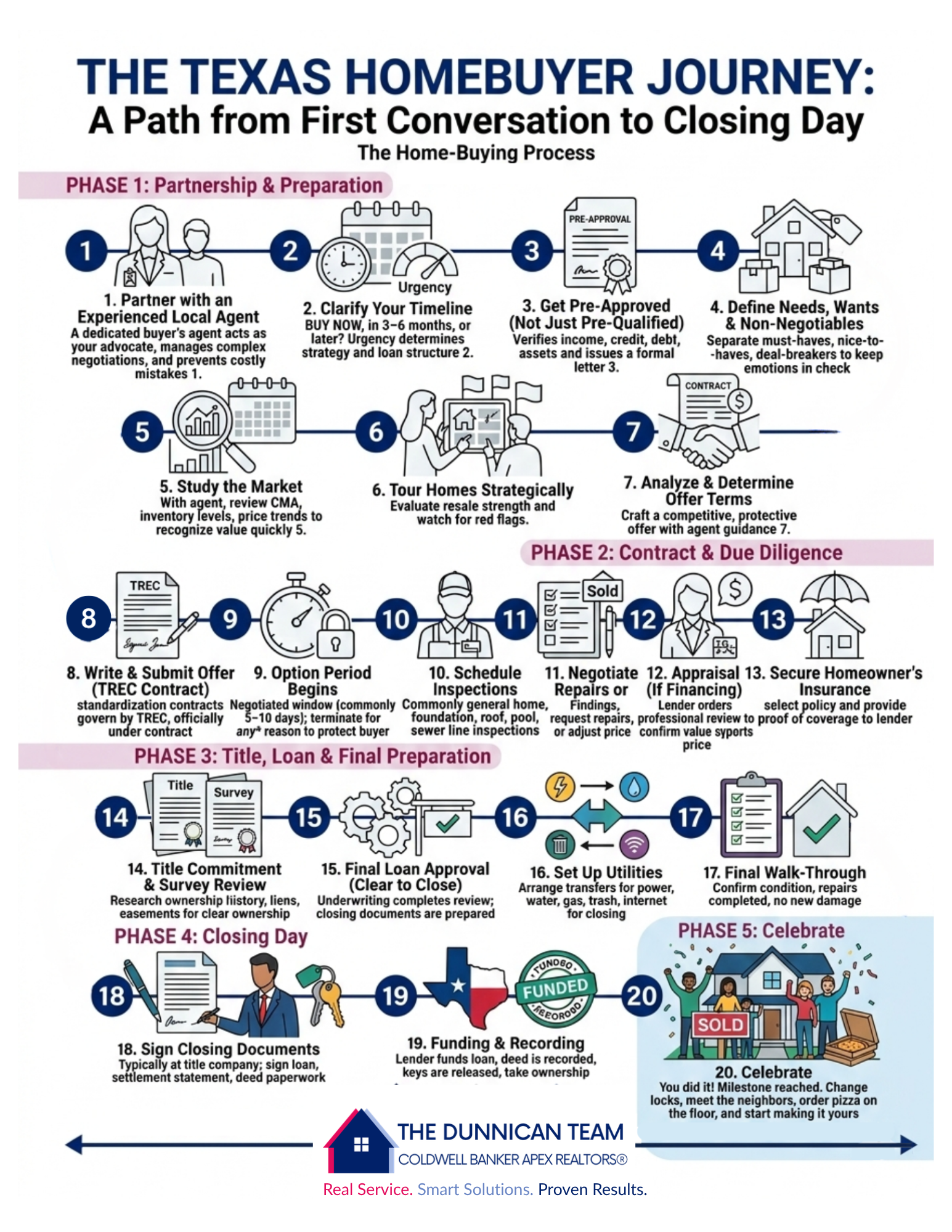
Every transaction moves through the same five phases. The steps are predictable. What changes is the pace — and having the right guidance at each stage.
Typical contract-to-close timeline: 30–45 days | Total process from first conversation: 6–10 weeks