


What should buyers and sellers know about foundation issues in Rowlett, Rockwall, Wylie, and the Northeast Suburban Dallas Area?
Foundation movement is common in North Texas because the region sits on Blackland Prairie "black gumbo" clay that swells when wet and shrinks in drought — putting constant pressure on slab foundations. Buyers should get a licensed structural engineer's report during the option period if there are any visible warning signs; a standard home inspection alone isn't enough. Sellers in Texas are legally required to disclose known foundation issues and previous repairs on the Seller's Disclosure Notice under Texas Property Code §5.008. With repairs ranging from a few thousand dollars to more than $30,000, addressing foundation concerns early — before listing or before going under contract — saves both sides real money and avoids the kind of mid-transaction surprises that kill deals.
By Cindy Dunnican | June 25, 2026
If you've looked at homes in Rowlett, Rockwall, Wylie, and the Northeast Suburban Dallas Area for more than a few weeks, you've probably noticed something: a crack in the brick here, a door that doesn't quite latch there, or floors that aren't perfectly level. North Texas is built on what geologists call Blackland Prairie clay — known locally as "black gumbo" — and it moves. It swells when it rains and shrinks when it dries, and it does both on a regular cycle that puts constant stress on slab foundations.
That doesn't mean every crack is a crisis. But it does mean buyers and sellers both need to understand foundation movement before they sign anything — because the costs and consequences are real, and they don't get smaller by ignoring them.
Why North Texas Foundations Move — and Why It's Especially Common Here
The soil beneath Rowlett, Rockwall and Wylie contains highly expansive clay minerals — part of the same Blackland Prairie formation that runs through much of Dallas, Collin, and Rockwall Counties. When the clay absorbs moisture, it expands. When it dries out, it contracts. That constant expansion and contraction cycle creates ground movement beneath your slab, and over years, it causes foundations to shift, settle, or crack.
Concrete slab foundations are the standard in this market, and for good reason — when properly built and maintained, they hold up well on expansive clay. But "holds up well" depends on two things: drainage away from the house, and consistent moisture in the soil around the perimeter. Let either one go — or let a dry Texas summer do its worst without irrigation — and you'll accelerate the movement significantly.
This is why North Texas homes that look pristine on the outside can still have foundation movement history. It's not a sign that the house was built poorly. It's often a sign that moisture management wasn't maintained over time.
What Buyers Need to Know Before Going Under Contract
Foundation movement is one of the most common deal-complicating findings in North Texas home inspections — and it's also one of the most misunderstood.
Here's the critical distinction: a standard home inspection is not a foundation inspection. Your inspector will identify visible symptoms — drywall cracks, sticking doors, unlevel floors, gaps between walls and baseboards — and flag them in the report. What a general home inspector typically cannot do is tell you whether the foundation is stable, actively moving, or in need of structural repair. That determination requires a licensed structural engineer (PE).
When you're touring homes in Rockwall, Heath, or Rowlett, here are the warning signs worth paying attention to:
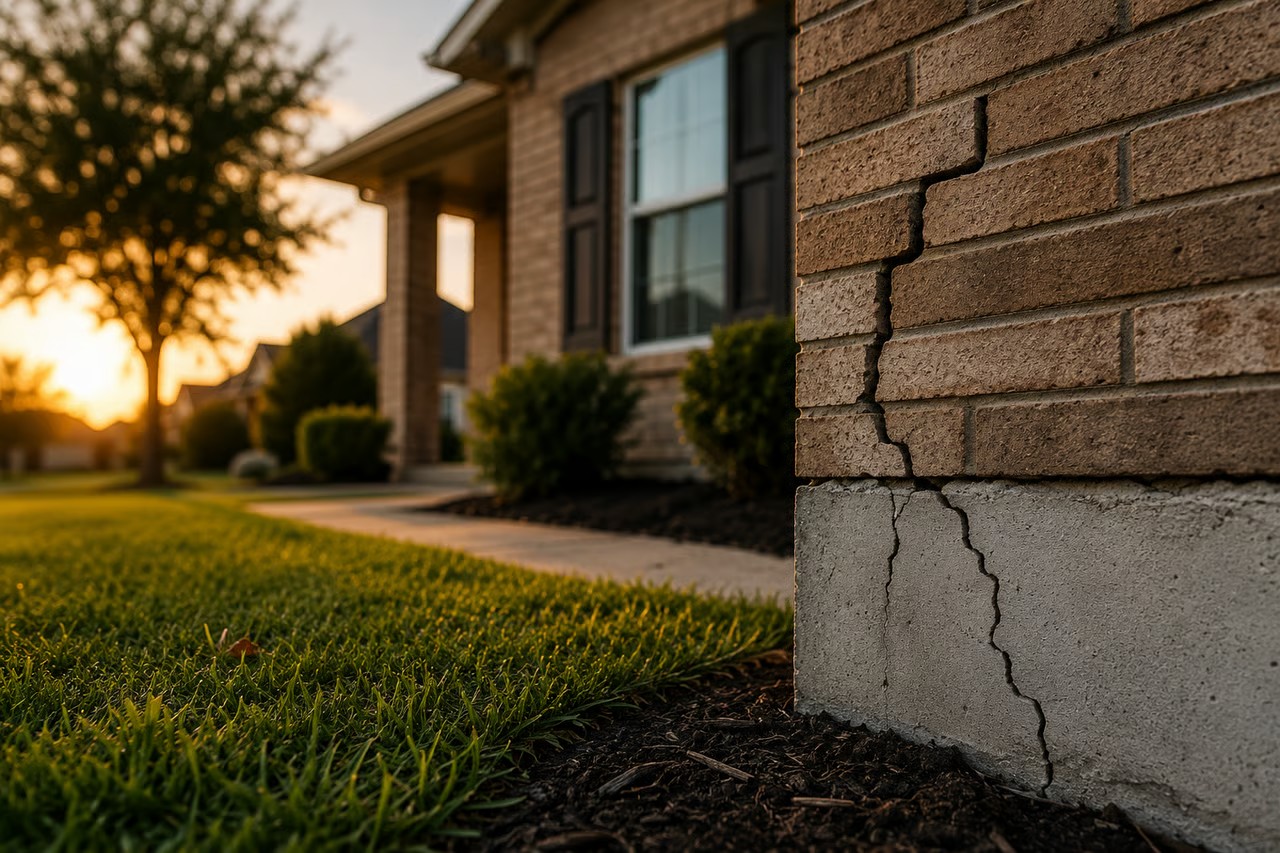
Stair-step cracks in exterior brick — diagonal cracking through the mortar joints that follows a staircase pattern indicates differential settlement beneath the slab
Diagonal cracks from corners of doors or windows — shear stress in the drywall caused by the house racking out of square
Doors that don't latch or bind at the top corner — the framing is no longer plumb
Frieze board separating from the brick, or gaps at exterior trim joints — the foundation is pulling away or dropping at a corner
Floors that are noticeably out of level — structural engineers start paying close attention at around ½ inch of slope across a room
None of these automatically means the home is a bad purchase. They do mean you need more information before proceeding.
Use the Option Period to Get the Right Report
In Texas, you have the option period — your termination option window, typically 7–10 days in the current Rockwall and Rowlett market — to investigate the property with no obligation to proceed. This is the window to get your full home inspection and, if any foundation concerns come up, a structural engineer's evaluation.
A PE foundation report in North Texas typically costs $400–$600. It gives you an independent, professional opinion on the foundation's current condition and a clear recommendation for any necessary repairs. Foundation repair company inspections, by contrast, are often free — but they're conducted by contractors who also sell the repair work, which creates an obvious conflict of interest. The Texas Board of Professional Engineers is clear on this: only licensed PEs have the technical background in soil mechanics and structural design to make these determinations. Spend the money on the PE report.
If you're starting your home search in Rockwall County and want to understand the full buying process before you get to this stage, our guide to how the Texas option period works covers the whole structure — from the option fee to how to use it effectively at inspection.
Negotiating After a Foundation Finding
If the engineer finds movement or recommends repairs, you have real options. The most common path in today's market is a repair credit at closing — the seller credits you money toward foundation work, and you handle the contractor and oversight yourself after closing. This is often preferable to requiring the seller to complete repairs, because it gives you control over who does the work and to what standard.
Homes with documented foundation issues in the DFW area typically sell for 10–15% below comparable properties without issues, even after repairs have been completed. If you go in with realistic pricing expectations and verify the engineering, a home with a known and repaired foundation history can represent real value — because you're pricing in a risk that the next buyer would face without warning.
What Sellers Need to Know Before Listing
If you're preparing to sell in Rockwall County or Rowlett, disclosure isn't optional: the Texas Seller's Disclosure Notice (required under Texas Property Code §5.008) specifically asks whether you're aware of any defects or malfunctions with your foundation or slab, any history of settling or soil movement, and any previous structural repairs. You must disclose what you know.
That's not just a legal requirement — it's the practical reality. Buyers in the current market are doing thorough inspections, and many are getting structural engineer evaluations as a matter of course. If a foundation issue surfaces on inspection that wasn't disclosed, your deal is likely to fall apart. Disclose it clearly on the front end, price accordingly, and let the buyer make an informed decision.
For a full walkthrough of what the Seller's Disclosure Notice covers and the changes that took effect in July 2026, see our post on what's new in the Texas Seller's Disclosure Notice.
Repair Before Listing vs. Selling As-Is
This is the real decision point for sellers, and the answer depends on the severity of the issue, your timeline, and your price point.
Repair before listing — If the problem is minor to moderate and repairable, this is usually the better path. Traditional mortgage lenders won't finance a home with active, unrepaired structural issues. That means a foundation problem that isn't addressed before listing effectively eliminates conventional buyers from your pool, leaving you with cash buyers and investors who will discount accordingly. Getting the repair done before you list opens the full market and typically produces better offers.
Selling as-is — If the damage is more extensive, or if speed matters more than maximizing net proceeds, selling as-is at a transparent, reduced price is a legitimate option. Cash buyers and experienced investors in North Texas are well-versed in foundation repair economics. Price the home accurately, disclose everything, and let the right buyer move forward.
The worst outcome — for both parties — is a foundation issue that surfaces mid-transaction without prior disclosure. That's when you lose the deal, the earnest money dispute follows, and everyone loses time. Getting a pre-listing structural engineer evaluation removes that uncertainty entirely.
Preventing Foundation Problems — and Protecting Your Investment
Whether you're a buyer taking ownership or a current homeowner planning to sell in a few years, maintenance makes a significant difference on North Texas clay. The steps that prevent movement are also the ones that protect your sale price:
Run a drip irrigation or soaker hose along the foundation perimeter during dry periods — especially May through September
Grade the yard so water flows away from the house — any slope toward the foundation accelerates clay expansion right where you don't want it
Extend downspouts at least 6 feet from the slab — concentrated water near the foundation is one of the fastest ways to create differential movement
Monitor mature trees — large root systems draw moisture from the clay in ways that can cause the soil to contract unevenly near the foundation
Consider a PE foundation evaluation every 5–7 years, especially on older homes — catching movement early costs a fraction of addressing it after significant settlement
Most foundation problems in Rowlett and Rockwall are the result of years of inconsistent moisture management, not irreversible structural failure. The homes that hold their value are the ones where owners paid attention to the basics. If you want a room-by-room breakdown of what to watch and when, we put together a North Texas foundation maintenance guide specifically for homeowners in this area.
Frequently Asked Questions
Does a standard home inspection cover foundation problems in North Texas?
A standard home inspection identifies visible symptoms of foundation movement — sticking doors, drywall cracks, unlevel floors — but does not constitute a structural evaluation. Only a licensed structural engineer (PE) can assess whether the foundation is stable, actively moving, or in need of repair. In North Texas, a PE foundation report typically costs $300–$600 and should be obtained during the option period if there are any visible warning signs.
What must a seller disclose about foundation issues in Texas?
Under Texas Property Code §5.008, sellers are required to complete a Seller's Disclosure Notice that specifically asks about defects or malfunctions with the foundation or slab, any history of settling or soil movement, and any previous structural repairs. Sellers must disclose what they know. Failing to disclose a known foundation issue can result in legal liability after closing.
How much does foundation repair cost in Rowlett and Rockwall, TX?
Foundation repair costs in North Texas range from around $2,200 for minor crack repair to more than $30,000 for significant pier installation and structural stabilization. The average repair for a typical North Texas slab issue falls between $5,000 and $15,000. Severity, the number of piers needed, and site accessibility all affect the final cost. Getting a structural engineer's assessment first — rather than relying on a foundation repair company's free estimate — gives you an unbiased cost projection.
Can you get a mortgage on a house with foundation problems in Texas?
Most conventional and FHA lenders will not finance a home with active, unrepaired structural foundation issues. If an inspection or appraisal surfaces significant foundation problems, the lender typically requires repairs to be completed and verified before closing. Sellers who repair foundation issues before listing open their home to the full conventional buyer pool. Buyers purchasing a home with known, unrepaired foundation damage typically need a cash purchase or a renovation loan.
How do I prevent foundation problems in my Rowlett or Rockwall home?
The most effective prevention in North Texas is maintaining consistent soil moisture around the foundation perimeter year-round — especially during hot, dry summers. A drip irrigation or soaker hose system along the slab edge, proper grading to direct water away from the house, and downspouts extended at least 6 feet from the foundation are the three highest-impact steps. Most foundation movement in Rowlett and Rockwall comes from preventable moisture imbalances rather than unavoidable soil conditions.
Foundation issues in North Texas aren't a dealbreaker — but they require honest attention from both sides of the transaction. Buyers who know what to look for and get the right engineering done can make confident decisions. Sellers who disclose accurately and address problems proactively protect their price and avoid the mid-deal surprises that derail closings.
If you're buying or selling in Rockwall, Rowlett, Heath, or the surrounding communities and want a straightforward read on how foundation history might affect your specific situation, reach out. We've been through enough of these transactions to know the difference between a cosmetic crack and a structural concern — and we can point you to the right professionals when it matters.
If you're weighing your next move as a seller, a free home valuation is the easiest place to start — it puts the current market context behind your specific property so you can plan from real numbers. You can request yours at thedunnicanteam.com/home-valuation.
If you're buying and want to understand everything we do to guide you from first showing to closing — including how we handle inspection and negotiation when foundation concerns come up — you can download our free guide at 90 Ways We Serve Buyers.
About Cindy Dunnican
Cindy Dunnican is the managing partner of The Dunnican Team at Coldwell Banker Apex, Realtors, serving the Northeast Dallas suburbs, Rockwall County, and the surrounding North Texas communities. Alongside her husband and business partner, Cory, she helps buyers and sellers navigate move-up purchases, downsizing, relocation, new construction, and luxury lake and golf course properties. Connect with The Dunnican Team at thedunnicanteam.com.
Check out this article next