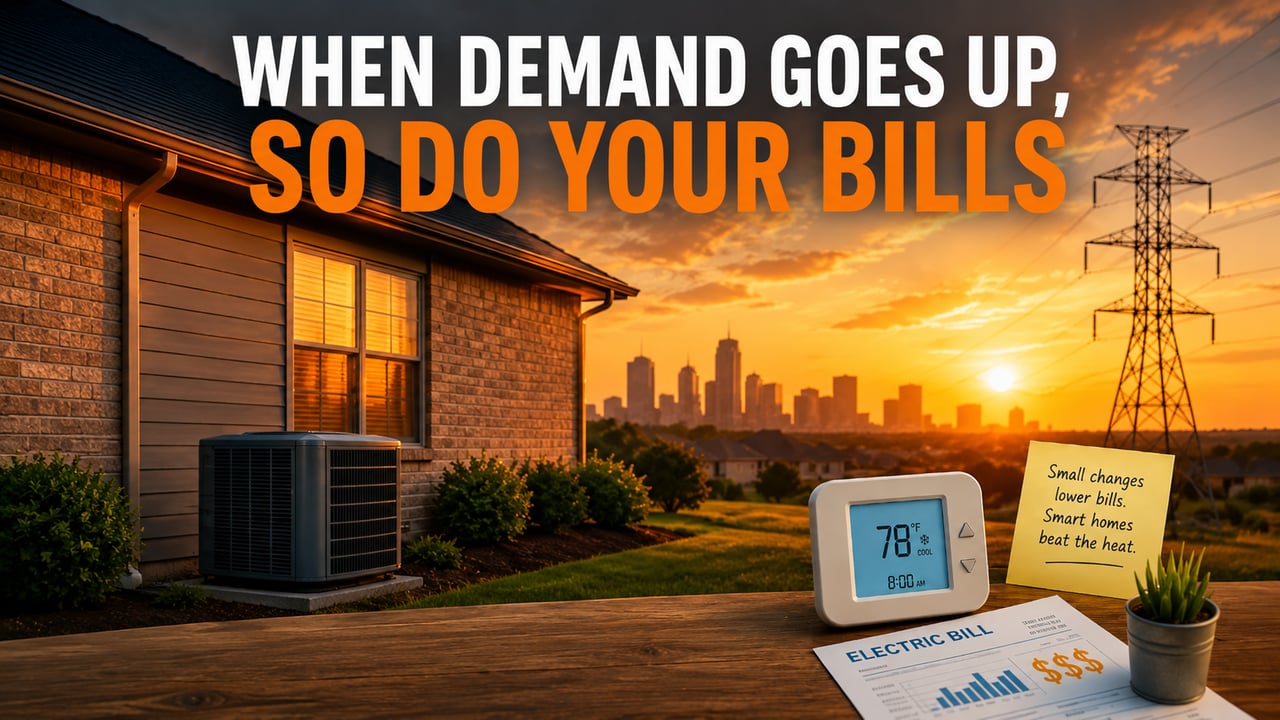
If you haven't seen the recent CultureMap Dallas headline, here's the short version: ERCOT — the Electric Reliability Council of Texas, which manages about 90 percent of the state's power grid — is bracing for a record-breaking summer. They're projecting peak demand of more than 92.2 gigawatts, enough to power roughly 18.4 million homes simultaneously, and that's on top of already-strained capacity driven by power-hungry data centers, crypto-mining facilities, and a growing Texas population. About 27 million Texas customers depend on that grid every single day.
Here's the part that hits your wallet: energy markets respond to demand. When everyone cranks up the AC on the same blazing July afternoon, wholesale electricity prices spike — and those spikes eventually show up in your utility bill, especially if you're on a variable-rate plan. The grid doesn't care if it's your home office, your neighbor's swimming pool pump, or a massive data center outside of Denton. When the load climbs, so does the cost.
The good news? You have more control over your energy use than you might think. Whether you live in a brand-new build or a house that's been settling since the 1970s, there are real, practical steps you can take to lower your consumption, reduce your bills, and take some pressure off the grid.
Start With the Thermostat — It's Still the Biggest Lever You Have
Your HVAC system is almost certainly your home's largest energy consumer in summer. Getting strategic with your temperature settings can make a meaningful difference without sacrificing comfort.
During the day when the house is occupied, setting your thermostat to around 78°F is the sweet spot recommended by the Department of Energy for balancing comfort and efficiency. If you're leaving for work or running errands, bump it up to 85°F — your AC shouldn't be cooling an empty house. In the evening, you can drop back down to 78°F or slightly below as outside temps fall. Overnight, many people sleep comfortably in the low-to-mid 70s, which is still significantly less work for your system than fighting a 100°F afternoon.
A programmable or smart thermostat makes all of this automatic. Set your schedule once, and it handles the rest. Some utilities also offer demand-response programs where you earn bill credits for pre-cooling your home in the morning and allowing a slight temperature rise during peak afternoon hours — typically between 3 and 7 PM. That's the window when ERCOT prices are most volatile and when your small sacrifice makes the biggest collective difference.
Caulking and Weatherstripping: Cheap Fixes with Real Returns
One of the most overlooked and cost-effective things you can do in any home — old or new — is seal the gaps. Heated or cooled air escaping through cracks around windows and doors is essentially money leaking out of your walls.
Caulking windows: Yes, it genuinely helps. Older windows in particular tend to have gaps between the window frame and the surrounding wall, as well as around the glass pane itself. Pick up a tube of paintable latex caulk and run a bead along any visible seams. It's a weekend project that costs under $20 and can make a noticeable difference in rooms that have always felt drafty or stuffy. Check both the interior and exterior sides — sealing from outside is often more effective at blocking heat infiltration.
Weatherstripping: Door seals degrade over time. If you can see daylight under or around an exterior door, you're losing conditioned air constantly. Foam tape, V-strip weatherstripping, or door sweeps are inexpensive and easy to install yourself.
The Hidden Culprit: Air Leaks Around Exterior Wall Outlets
Most homeowners never think about this one, but electrical outlets and switch plates on exterior walls can be significant sources of air infiltration. The wiring that runs through your walls creates pathways that connect directly to the outside, and in older homes those gaps are rarely insulated.
The fix is simple and inexpensive: pick up foam outlet gaskets at any hardware store. They're pre-cut insulating pads that slip behind your outlet and switch plate covers. You just unscrew the cover plate, place the gasket, and screw it back on. Takes about two minutes per outlet. For even better performance, pair these with childproof outlet plugs on unused outlets — they help block air movement through the outlet holes themselves. In a house with dozens of exterior outlets and switches, this small fix can add up to a real reduction in air leakage.
That Hot Bedroom: Taming Morning Sun Through Windows
If your bedroom faces east and you're waking up in a sweltering room by 8 AM even with the AC running, the problem isn't your HVAC — it's solar heat gain through the glass. Sunlight converts to heat once it enters your home, and a single unshaded east- or west-facing window can add significant load to your cooling system.
You have several good options here:
Blackout shades are the most effective at blocking heat because they block light entirely. They're ideal for bedrooms where you want to sleep later or simply don't want the room to heat up early. Quality blackout cellular shades also provide an insulating air pocket that further reduces heat transfer through the glass.
Light-filtering shades are a middle ground — they soften and diffuse sunlight, reducing glare and some heat gain while still letting natural light into the room. They won't cut as much heat as blackout, but they're a good choice for living spaces where you still want daylight.
Solar screens are an excellent exterior solution that's especially popular in Texas. These mesh screens install on the outside of the window and block 70–90% of solar radiation before it ever hits the glass. Unlike interior shades, solar screens reduce heat gain at the source. They still allow some outward visibility, and they're particularly effective on west- and east-facing windows that get direct sun. Many Texas homeowners report noticeable drops in their energy bills after installing them on the sun-facing sides of their homes.
Pet Doors: Small Opening, Big Air Leak
Pet doors are convenient, but they're also uninsulated gaps in your exterior wall or door — and they can create a surprising amount of air infiltration, especially if they're older models with worn flap seals.
If you have a pet door that's seen better days, start by replacing the flap if possible. Many manufacturers sell replacement flaps that create a better seal. For a more permanent upgrade, consider a dual-flap or magnetic-closure pet door, which creates a small air pocket between two sealing layers and significantly reduces air exchange. Some higher-end models are even energy-rated and come with foam-sealed frames.
If the pet door is in a door to the garage rather than directly to the outside, the urgency is somewhat lower — though garage temperatures still affect your home. For doors that open directly to the exterior in Texas summers, it's worth investing in the best seal you can get.
Older Homes: Specific Challenges, Practical Solutions
If your home was built before the 1990s, it was almost certainly built to energy standards that wouldn't pass muster today. That doesn't mean you're stuck paying premium bills forever — it means you need to prioritize the right upgrades.
Attic insulation is the single highest-impact improvement in most older homes. Heat enters from the roof and radiates down through inadequate insulation directly into your living space. Modern recommended insulation levels for Texas attics are R-38 to R-60. Many older homes have R-11 or less. Adding blown-in insulation is relatively affordable (often $1,500–$3,500 for a typical home) and can cut cooling costs significantly. Some utility companies offer rebates that reduce the cost further.
Duct leakage is another major problem in older homes. Leaky ducts can mean that 20–30% of your cooled air never reaches the living space — it just escapes into the attic or crawl space. A professional energy audit can identify duct leaks, and sealing them with mastic sealant or metal tape (not standard duct tape, which fails over time) can make a dramatic difference.
Single-pane windows are essentially just glass standing between you and the outside temperature. If full window replacement isn't in the budget, adding interior storm window inserts or window film can meaningfully reduce heat gain. Low-E window film is a DIY-friendly product that you apply to the interior glass surface — it reflects infrared heat while still allowing visible light through.
Ceiling fans are your friend in older homes. Running a ceiling fan in the counterclockwise direction in summer creates a wind-chill effect that makes you feel cooler at a higher thermostat setting — the fan itself uses about as much electricity as a light bulb.
General Conservation Tips That Make a Collective Difference
Every bit of reduced demand during peak hours helps keep prices lower for everyone on the grid.
Run your dishwasher, washing machine, and dryer in the early morning or after 8 PM to avoid peak demand windows. Switch to LED lighting if you haven't already — LEDs use up to 75% less energy than incandescent bulbs and produce significantly less heat. Unplug electronics and chargers when not in use; standby power ("phantom load") can account for 5–10% of home energy use. Check that your refrigerator coils are clean — dirty coils force the compressor to work harder. If you have an older water heater, wrapping it in an insulating blanket and lowering the temperature to 120°F can reduce that load as well.
The Bottom Line
ERCOT's record-demand warning is a signal worth taking seriously — not because the grid is about to fail, but because high demand is directly linked to higher energy costs for Texas consumers. The steps above aren't about hardship or sacrifice. They're about spending a little time and modest money now to significantly reduce what you spend all summer long. Whether you tackle one project this weekend or work through the list over the coming weeks, every improvement you make is a step toward a cooler home, a lower bill, and a little less pressure on a grid that's already working at its limit.
Sources: CultureMap Dallas / InnovationMap, "ERCOT braces for record-breaking power demand across Texas this summer," June 9, 2026