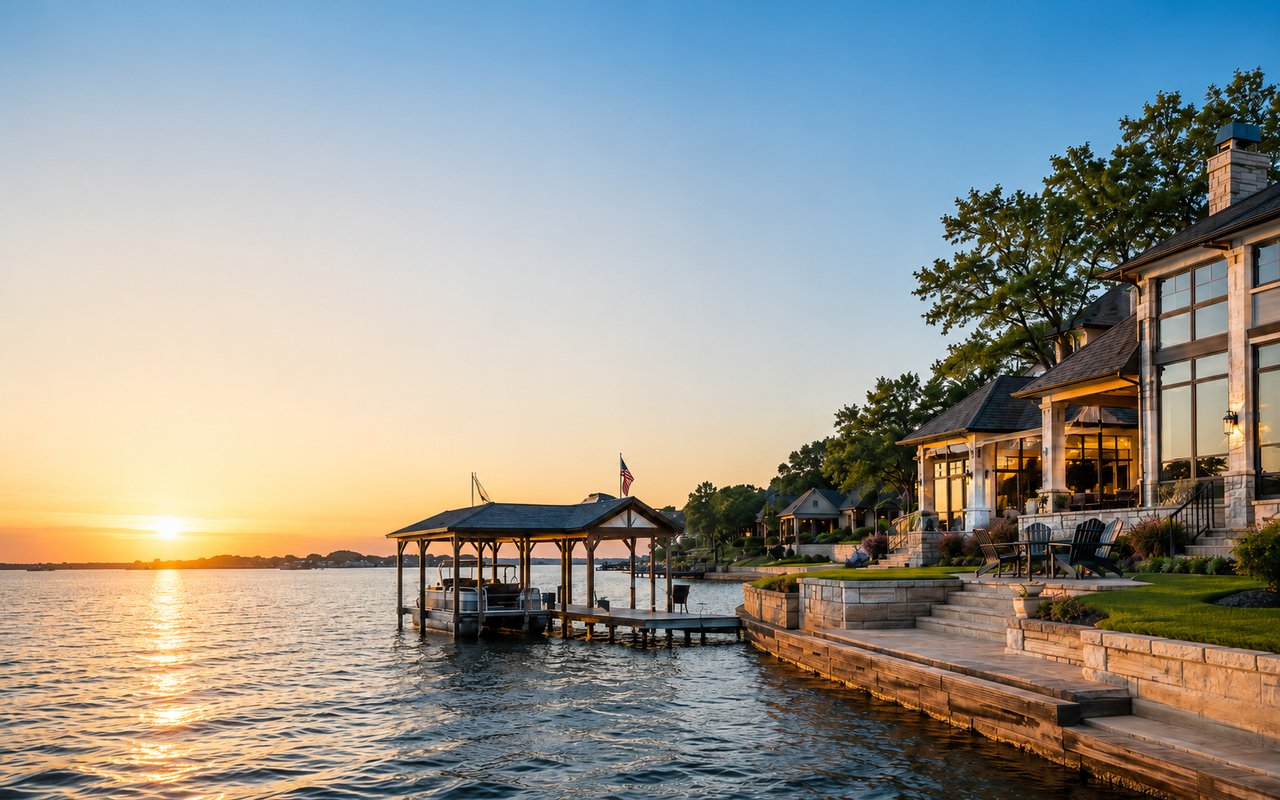

What Is a True Lakefront Home Worth on Lake Ray Hubbard?
Based on 33 true lakefront closed sales in Rowlett, Rockwall, and Heath between August 2025 and July 2026, true lakefront homes on Lake Ray Hubbard sold for 65%–90% more than comparable non-lakefront homes, with an 80% midpoint and a median dollar premium of approximately $551,000.
If your non-lakefront neighbor just sold for $500,000 and you own a true lakefront home a few streets away, you are not in the same market. You're in a different one — with a different buyer pool, a different comp set, and a pricing conversation that starts significantly higher. The question isn't whether your home is worth more. It's how much more, and what specifically drives that number.
After analyzing 33 closed lakefront sales across Rowlett, Rockwall, and Heath over the past year, the premium range for a true lakefront lot runs from 65% to 90% above the value of a comparable non-lakefront home, with 80% as the best overall midpoint. That same $500,000 neighbor comp translates to an indicated lakefront value of $825,000 to $950,000 — if the right features are in place. But the range is wide, and not every lakefront home earns the top end. Here's what the data shows.
First: What Counts as a True Lakefront Home
This distinction matters more than most sellers realize, and it's worth being direct about it.
A true lakefront home has a lot that abuts Army Corps of Engineers property — meaning your lot line ends where the Corps' land begins. You have the ability to lease the land between your property and the lake from the City of Rowlett, and that lease is what gives you the right to pursue shoreline improvements like retaining walls, docks, and boathouses.
Many homes listed in MLS as "waterfront" are not true lakefront by this definition. Some back to a community lake or pond. Others — including homes in Lake Park, The Vineyards, Bayside, and Sapphire Bay — face open water but are separated from the shoreline by a street, a city park, or HOA-controlled common area. Those homes offer beautiful views and real lifestyle value, but they're a different product. Buyers who understand the distinction value them differently, and they should be priced accordingly.
For the purposes of this post and the data behind it, we're talking exclusively about true lakefront lots.
What the Data Shows: 33 Closed Sales, One Year
Over the past year, there were 33 true lakefront sales across Rowlett, Rockwall, and Heath — the full market for true lakefront access on Lake Ray Hubbard. Lakefront land in all three cities is essentially built out. There is no meaningful inventory of vacant residential lakefront lots left to develop, which is a significant part of what gives these properties their pricing power. Buyers who want true waterfront access on Ray Hubbard have to buy an existing home.
The greatest concentration of closed sales came from Bayview Estates, Point Royal, and Toler Bay in Rowlett, and Northshore and Hillcrest Shores/The Shores in Rockwall. Heath's lakefront sales were spread across Heath Golf & Yacht Club, Lakeview Meadows, Meadow Lake Village, Windward Slope, Yankee Creek, and E.W. Terry's Land. Other Rowlett subdivisions with sales included Chantilly, Heritage Lake, Lakeside Village Estates, Mallard Cove, Mariner Park, Ridgecove, Southbay Estates, Stone Hollow, Stone Meadow Lake, and Waters Edge. Each of these neighborhoods has its own character, price range, and shoreline profile — which is exactly why a single "lake premium" percentage doesn't tell the full story.
Closed prices ranged from $470,000 to $4,100,000 across the three-city dataset. The premium isn't applied uniformly — it reflects what each property actually offers at the water.
What Your Neighbor's Sale Actually Tells You
One of the most common mistakes lakefront sellers make is anchoring their price to nearby non-lakefront sales. Your neighbor's comp is useful — but only as a starting point. The table below shows what a non-lakefront sale implies for a true lakefront property at the same location, using the 65%–90% range from the data.
Non-Lakefront Comp | Low (65%) | Midpoint (80%) | High (90%) |
|---|---|---|---|
$350,000 | $577,500 | $630,000 | $665,000 |
$450,000 | $742,500 | $810,000 | $855,000 |
$500,000 | $825,000 | $900,000 | $950,000 |
$600,000 | $990,000 | $1,080,000 | $1,140,000 |
$750,000 | $1,237,500 | $1,350,000 | $1,425,000 |
$1,000,000 | $1,650,000 | $1,800,000 | $1,900,000 |
$1,500,000 | $2,475,000 | $2,700,000 | $2,850,000 |
These ranges are preliminary estimates, not appraisals. Where your property falls within the range depends on dock status, frontage footage, shoreline type, retaining wall, water depth, and the condition of your Corps lease documentation. A full CMA using actual lakefront comparables is the right next step.
The other thing this table makes clear: the citywide Rowlett median of $376,165 is not your benchmark. It's the median for all single-family sales in the city — mostly non-lakefront homes. Using it to anchor a lakefront pricing conversation will almost certainly leave money on the table.
This is where the analysis gets specific, and where the gap between a 69% premium and a 94% premium becomes clear.
Dock vs. No Dock
The single biggest variable in the data is whether the property has a dock.
with dock listed
without dock
That gap is significant. A dock on Lake Ray Hubbard isn't just a recreational amenity — it signals that the lot has sufficient frontage, that the shoreline permits have been navigated, and that the water is deep enough and accessible enough to make private boating practical. Buyers pay for that certainty.
One thing sellers need to understand: the ability to build a dock is not guaranteed on every lakefront lot. The City of Rowlett and the Army Corps of Engineers require a minimum of 60 linear feet of shoreline frontage before a dock permit can be issued. A lot with 55 feet of frontage and a lot with 75 feet of frontage may look similar on paper, but they're in fundamentally different pricing categories.
Main Body vs. Cove Frontage
Not all shoreline on Ray Hubbard is equal in terms of what buyers experience.
main body frontage
cove / non-main-body
Main body access means open water — room to run a boat, expansive views, and no concerns about whether a cove dries up during drought conditions. Lake Ray Hubbard has areas that regularly lose significant water depth during hot, dry summers, and experienced buyers know to ask about it. Cove-adjacent lots may offer protection from wind and wave action, but they trade off on depth, access, and the view buyers are actually paying for.
Retaining Wall vs. No Retaining Wall
with retaining wall
without retaining wall
A steel or concrete retaining wall at the shoreline isn't cosmetic — it's a meaningful capital improvement that protects the lot, stabilizes the bank, and is typically a prerequisite for dock installation. A new steel retaining wall can run $30,000–$50,000 or more depending on linear footage and conditions, and a concrete wall is typically more expensive than steel. When that work is already done and documented, buyers don't have to price in the cost and uncertainty of doing it themselves.
Rowlett, Rockwall, and Heath
The three-city dataset tells an interesting story. Rowlett's 20 sales showed a median dollar premium of approximately $322,000 at a 72.5% rate. Rockwall's 6 sales showed a median dollar premium of approximately $683,000 at a 96.4% rate — reflecting larger lots, higher-end custom construction, and main body frontage on the western side of the lake.
Heath's 7 sales are worth understanding carefully. The median percentage premium was approximately 68% — lower than Rockwall's in this sample — but the median dollar premium was approximately $1,010,000. That's not a contradiction. Heath's non-lakefront homes already sell at significantly higher prices than their Rowlett or Rockwall counterparts, so a 68% lift on a $1.5M non-lakefront value produces a larger dollar number than a 96% lift on a $700K non-lakefront value. If you own a lakefront home in Heath Golf & Yacht Club, Meadow Lake Village, or similar, your pricing conversation starts at a different baseline entirely.
All three cities have small sample sizes at the lakefront level — the entire market produced 33 sales in a year. The city-level premiums should be read as directional patterns, not precise formulas.
The Hidden Costs Buyers Don't Always Price In
One reason lakefront negotiations sometimes stall is that buyers arrive without a full picture of what it actually costs to maximize a lakefront property. As a seller, understanding these costs helps you anticipate buyer concerns and present your property's existing improvements clearly.
To use the land between your lot line and the lake — for a retaining wall, dock, or landscaping improvements — you need a sublease from the City of Rowlett, which manages the leasehold from the Corps. Two homes described as "lakefront" can have very different practical situations depending on whether the lease is current, what it permits, and what improvements have already been approved. Sellers who have clean paperwork — current subleases, permits, survey records, and improvement history — have a measurable advantage.
Steel or concrete, the cost is significant and the choice matters. Steel is generally less expensive upfront; concrete is more durable and often carries a higher perceived value. If your wall is already in place and in good condition, that's a selling point worth quantifying explicitly in your marketing.
A permitted, installed covered dock with boat and jet ski lifts represents a substantial investment — often $60,000 to $150,000 or more for quality construction. Buyers who are looking at a lot without a dock are mentally pricing in that work, plus the permitting timeline and the 60-foot frontage minimum. If your dock is permitted and operational, it is almost certainly contributing more than its replacement cost to your sale price.
A Note on Flood Risk
Flooding is not typically a significant concern for true lakefront properties on Lake Ray Hubbard the way it can be for properties along creek corridors or in lower-lying areas. The lake's water level is managed, and the shoreline areas where most of these properties sit tend to have better drainage characteristics than lower-lying neighborhoods nearby. If you have questions about your specific property's flood zone designation, the FEMA flood map service center is the place to start.
What to Have Ready Before You List
Lakefront sellers who come to market with documentation in order consistently have smoother transactions and stronger negotiating positions. Buyers — especially experienced waterfront buyers — ask specific questions. Having answers ready isn't just good preparation; it signals that the property has been properly maintained and managed, which directly supports your price.
Locate your current sublease from the City of Rowlett for the take area between your lot and the lake. Confirm it's current, that it covers your existing improvements, and that any permits for past work are attached. If anything is missing or lapsed, address it before listing — buyers who discover gaps during due diligence will use them as negotiating leverage.
If you have a dock, gather the original permit, any inspection records, and documentation of the lift equipment. Buyers want to know the dock is permitted, in good working order, and transferable. A permitted dock with records is worth more in the negotiation than an unpermitted one — even if they look identical from the water.
Know what your wall is made of (steel or concrete), when it was installed or last inspected, and by whom. If you have a warranty or contractor records, have those ready. Buyers routinely ask about the wall's condition and remaining life, and a seller who can answer specifically is in a stronger position than one who can't.
A current survey that clearly shows your lot line relative to the Corps boundary, your frontage footage, and the location of any shoreline improvements is one of the most useful documents you can provide. It eliminates ambiguity about what the buyer is actually getting and often prevents due diligence issues before they start.
Lakefront homes sell on what the water looks like from the property — not just what the interior looks like. Aerial drone footage showing the lot's relationship to the lake, video of the dock and shoreline access, and photos taken at different times of day all help buyers understand and assign value to what they're purchasing. Buyers can't pay for features they can't see clearly.
Frequently Asked Questions
Based on 33 closed true lakefront sales in Rowlett, Rockwall, and Heath between August 2025 and July 2026, the premium ranges from 65% to 90% above a comparable non-lakefront home, with 80% as the best overall midpoint and a median dollar premium of approximately $551,000. Properties with docks and main-body frontage tend to command premiums at or above the high end of that range.
Only as a starting point. If your neighbor's non-lakefront home sold for $500,000, that comp implies an indicated lakefront value of $825,000 to $950,000 — but your actual price depends on dock status, frontage footage, shoreline type, retaining wall, and Corps lease documentation. The citywide median isn't a useful benchmark for lakefront pricing at all. You need lakefront-to-lakefront comparables.
Yes — substantially. In this analysis, lakefront homes with a dock listed sold at a median premium of approximately 94% over their estimated non-lakefront value, compared to approximately 69% for homes without a dock. The ability to build a dock also matters: the Corps of Engineers and the City of Rowlett require a minimum of 60 linear feet of shoreline frontage for dock permit eligibility, so not every lakefront lot qualifies.
A true lakefront home has a lot that abuts Army Corps of Engineers property, with the ability to lease the intervening land from the City of Rowlett for shoreline improvements. Many MLS listings are marked "waterfront" but actually back to a street, city park, HOA common area, community pond, or creek. These properties may offer water views or proximity but not true shoreline access or dock rights, and the pricing difference between the two can be significant.
A new steel seawall typically runs $30,000–$50,000 or more depending on linear footage and site conditions; concrete walls tend to run higher. In the closed sales data, homes with a retaining wall in place sold at a median premium of approximately 80% above their non-lakefront value, compared to approximately 67% for those without one. The wall protects the shoreline, stabilizes the bank, and is generally required before a dock can be installed.
Extremely scarce. There is no meaningful inventory of vacant residential lakefront lots available in Rowlett, Rockwall, or Heath. Buyers who want true lakefront access on Ray Hubbard must purchase an existing home. Over the past year, there were only 33 closed true lakefront sales across all three cities — an average of fewer than three per month in the entire market.
Find Out What Your Lakefront Home Is Actually Worth
There were 33 true lakefront sales in Rowlett, Rockwall, and Heath over the past year. That's the entire market. If you're thinking about selling, you're not competing with hundreds of listings — you're competing with two or three. Getting your pricing right from the start matters more here than almost anywhere else.
Cindy Dunnican and The Dunnican Team have represented lakefront buyers and sellers on Ray Hubbard for over 25 years. Call for a no-pressure conversation — we'll tell you exactly where your property sits in this market.