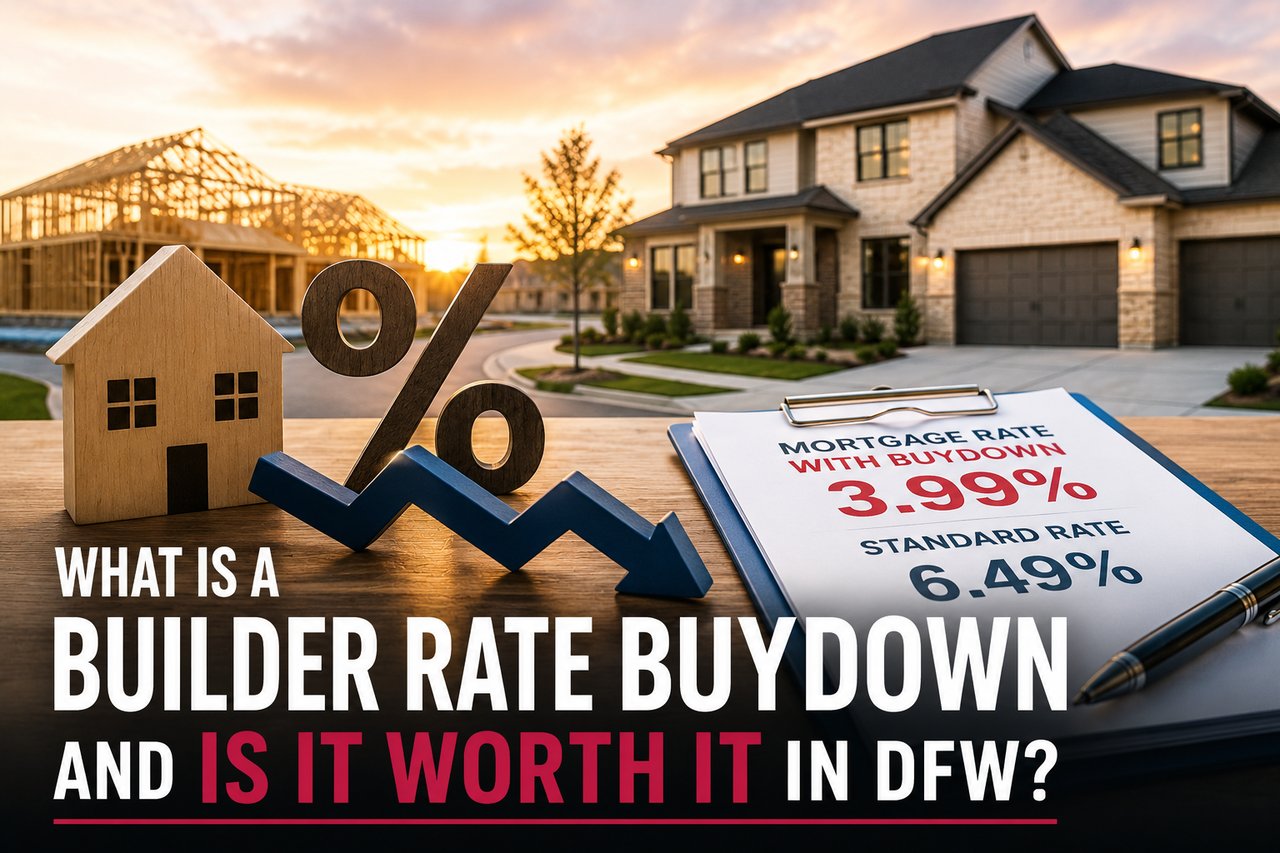
What is a builder rate buydown and is it worth it in DFW?
A builder rate buydown is an incentive where the home builder pays to lower your mortgage rate — either temporarily for the first two to three years or permanently for the life of the loan. In the DFW market in 2026, roughly 70% of new home sales include some form of rate buydown or financing credit. The catch: almost all of these incentives require you to finance through the builder's preferred lender, which may carry a higher base rate that partially offsets what you're saving. Before you sign, you should compare the builder's full loan terms against at least two outside lenders — including APR, not just the advertised rate.
By Cindy Dunnican | June 23, 2026
If you've been shopping new construction in Fate, Royse City, or anywhere in the eastern DFW corridor, you've probably seen the advertising: rates as low as 3.25%, $20,000 in flex cash, 2-1 buydowns with builder-paid closing costs.
These are real incentives. But "real" doesn't automatically mean "great deal." Understanding exactly how they work is the difference between getting genuine value and paying more than you realized over the life of your loan.
Here's what you actually need to know before you sign a new construction contract in 2026.
What a Builder Rate Buydown Actually Is
A rate buydown means a lump sum is paid at closing to reduce your mortgage interest rate. Builders in DFW offer two main versions:
Temporary 2-1 buydown: Your rate is reduced by 2 percentage points in year one, 1 percentage point in year two, then reverts to the full contract rate in year three and beyond. The funds are set aside at closing — paid by the builder. If you refinance or sell before the money is used up, you may get the remainder back, but most buyers hold long enough that the savings period simply ends.
Permanent buydown: The builder pays "points" at closing to lock in a reduced rate for the life of the loan. Your rate is just lower, permanently — but the upfront cost to the builder is higher, so you see this structure less often.
The 2-1 temporary buydown is by far the most common structure you'll encounter in Fate, Royse City, and Lavon right now. On a $400,000 loan at a 6.75% rate, a 2-1 buydown saves roughly $300–$400 per month in year one and $150–$200 per month in year two, before reverting to the full payment in year three.
That's real money for the first two years. But those savings come with conditions worth understanding.
Why Builders Offer Buydowns Instead of Cutting the Price
This is one of the first questions buyers ask — and the answer is strategic.
Large national production builders like Lennar, D.R. Horton, and Meritage track what homes sell for in each community because those sale prices become the comps that appraisers use for every future home in the subdivision. If a builder drops the base price by $20,000, every other home in that community is affected — appraisals drop, neighboring homeowners lose equity, and the builder's model becomes harder to sell at full price next quarter.
A rate buydown or closing cost credit doesn't show up in the recorded sale price the same way a price cut does. The builder keeps the headline price intact while making the monthly payment more attractive to buyers who are comparing options.
That's not a hidden scheme — it's how the business works. But it means the incentive you're being offered is not the same thing as a lower purchase price, and evaluating it that way will lead to a clearer decision.
The Preferred Lender Question
Almost every builder rate buydown in DFW comes with one requirement: to receive the incentive, you must finance through the builder's preferred lender.
This is where buyers often get surprised.
Builders have financial relationships with their preferred lenders — referral arrangements that are legal under RESPA but structured in ways that benefit the builder's sales process. Those lenders may offer genuinely competitive rates, or they may carry a base rate that's slightly above market, with the buydown partially offsetting the difference. The only way to know which situation you're in is to run the numbers side by side.
Under federal RESPA rules, a builder cannot legally require you to use a specific lender as a condition of purchasing the home. But they can — and do — make the incentive package conditional on using their preferred lender. If you want the $20,000 in flex cash applied to a rate buydown or closing costs, you'll need to finance through their lender to collect it.
You have every right to use your own lender. The question is whether the builder's lender terms plus the incentive add up to a better deal than what you can get with an outside lender at a lower base rate — without the incentive at all.
How to actually compare the offers:
- Get the full loan estimate from the builder's preferred lender — rate, APR, origination fees, and monthly payment at completion
- Get quotes from at least two outside lenders on the same loan amount
- Calculate total interest cost over 5–7 years (the typical DFW hold period), not just the first two years of the buydown period
- Add MUD and PID tax assessments to the new build's true monthly cost, if applicable
- Compare that total against a resale purchase in the same price range in Rowlett, Rockwall, or Wylie
That last point matters a lot in Fate, Royse City, and Lavon. Many new communities in those areas carry MUD and PID tax assessments that add $300–$400 per month to the total cost of ownership — costs that typically don't apply to resale homes in established parts of Rowlett or Rockwall. A builder's 2-1 buydown that saves $350 per month in year one may simply be covering the MUD assessment you're picking up at the same time. We covered this in detail in our guide to buying new construction in North Texas, and it's one of the most important numbers to get right before you compare options.
What You Can (and Can't) Negotiate with DFW Builders
First-time new construction buyers sometimes assume the builder's terms are fixed. They're not exactly fixed — but the levers are different from a resale purchase.
What builders protect: The base price per square foot and the lot premium. These affect recorded sale prices and appraisals for every other home in the community.
What builders will often adjust: Closing cost credits, design center allowances, upgraded appliance packages, extended rate lock periods, and the structure of the buydown itself. End of fiscal quarter is when major public builders are most motivated. Lennar and D.R. Horton both have fiscal years ending in November/December, making the June 30 quarter close a meaningful moment to negotiate — builders want to hit their unit and revenue numbers before the quarter ends.
On quick move-in homes — homes that are complete or nearly complete and sitting unsold — builders have significantly more flexibility than on dirt contracts. They're carrying the carrying cost of that finished home every month, which creates genuine incentive to make a deal.
One practical note that catches buyers off guard: if you plan to work with a buyer's agent, bring them with you on the very first visit to the model home and confirm they're registered. Most DFW builders require agent registration on the initial visit to honor the buyer representation arrangement. Walking in unrepresented first and asking to "add" an agent later is often not an option. For more on how buyer representation works in Texas under the new SB 1968 rules, our first-time buyer's guide for Wylie covers the essentials of working with an agent in the current market.
Your agent can review the builder contract (which looks nothing like a standard TREC contract), compare incentive packages across multiple communities, and help you evaluate the financing math — at no cost to you as the buyer.
The Honest Resale vs. New Construction Comparison
The resale-versus-new-construction question is live across Rowlett, Rockwall, and the eastern growth corridor right now. Builders in Fate and Royse City are competing directly for buyers who could also purchase an established home closer to Lake Ray Hubbard in Rowlett or in one of Rockwall's established neighborhoods.
The comparison is never as simple as the buydown-adjusted monthly payment on the new build versus the asking price on the resale. A complete picture includes:
- MUD/PID assessments on the new construction (add $300–$400/month in many eastern DFW communities)
- Property tax rate differences between cities and school districts — the City of Rockwall has the lowest combined property tax rate of any major DFW suburb at roughly 1.57%, while Fate and Royse City carry different rates that can push the total higher
- Foundation and inspection risk on resale homes — North Texas clay soil creates movement that shows up on inspections, particularly on homes 20–30 years old, with repair costs ranging from $5,000 to $25,000 for serious issues
- Commute and location — eastern Fate and Royse City are farther from I-30 than central Rowlett or Rockwall, and the I-30 expansion project (bridge completion projected late 2026–early 2027) is still working through construction delays that affect commute times
Getting this comparison right — with real numbers for the specific homes you're considering — is exactly what a local agent who knows both markets can help you do.
Frequently Asked Questions
Is a 2-1 builder buydown worth it in DFW?
It depends on the full comparison. A 2-1 buydown saves real money in years one and two, but the savings only matter if the builder's preferred lender isn't charging a higher base rate that offsets the benefit. Get the complete loan estimate from the builder's lender and compare it against at least two outside lenders — including APR, not just the advertised rate — before deciding. Then factor in any MUD/PID taxes that apply to the community.
Can a builder in Texas require me to use their preferred lender?
No. Under RESPA, a builder cannot legally require you to use a specific lender as a condition of purchasing the home. However, builders can — and legally do — require you to use their preferred lender to receive specific incentives like rate buydowns or closing cost credits. You always have the right to shop your own financing; the question is whether the builder's deal plus the incentive beats what you can get independently.
What is a 2-1 buydown and how does it work in practice?
A 2-1 buydown reduces your mortgage rate by 2 percentage points in the first year and 1 percentage point in the second year, then returns to the full contract rate from year three onward. The funds to cover the difference are set aside at closing — typically paid by the builder. On a $400K loan at 6.75%, this typically saves $300–$400 per month in year one and roughly $150–$200 per month in year two.
What's the catch with builder rate buydowns?
The main risk is evaluating the deal based only on the first two years of monthly payment savings rather than the total loan cost over your hold period. From year three onward, you're paying the full rate. If the builder's preferred lender also carries a higher base rate than what you could get elsewhere, the buydown may only partially offset that difference — leaving you no better off (or worse off) than if you'd used an outside lender without any builder incentive.
Should I bring a buyer's agent to a new construction appointment in DFW?
Yes — and you should bring them to the very first visit. Most DFW builders require your agent to be registered on the initial model home visit to honor the buyer representation arrangement. Walking in unrepresented first and asking to "add" an agent later is often not permitted under the builder's policy. Your agent can review the builder contract, compare incentive packages across multiple communities, and help you evaluate the financing options at no cost to you as the buyer.
Builder incentives in DFW are at their most competitive heading into the end of June — it's the halfway point of the fiscal year for major public builders, and inventory in eastern DFW is high enough that Lennar, D.R. Horton, and others have real motivation to close deals. That creates genuine opportunity for buyers who know what they're evaluating.
If you're comparing new construction communities in Fate, Royse City, or Lavon against resale homes in Rowlett, Rockwall, or Wylie, I can walk through the full comparison with you — financing math, tax district impact, inspection considerations, and what the resale market looks like right now in each area.
If you're starting your search or want to understand exactly how we represent buyers through this process, you can download our free guide to the 90 ways we serve buyers from first showing through closing at thedunnicanteam.com/for-buyers/90-ways-free-download. Or reach out directly and we'll start with your specific situation.
About Cindy Dunnican
Cindy Dunnican is the managing partner of The Dunnican Team at Coldwell Banker Apex, Realtors, serving the Northeast Dallas suburbs, Rockwall County, and the surrounding North Texas communities. Alongside her husband and business partner, Cory, she helps buyers and sellers navigate move-up purchases, downsizing, relocation, new construction, and luxury lake and golf course properties. Connect with The Dunnican Team at thedunnicanteam.com.