Contact
Office Locations
Home Office:
The Dunnican Team
9106 Royal Burgess Dr
Rowlett TX 75089
Rockwall Office:
Coldwell Banker Apex, Realtors®
2555 Ridge Road #144
Rockwall TX 75087
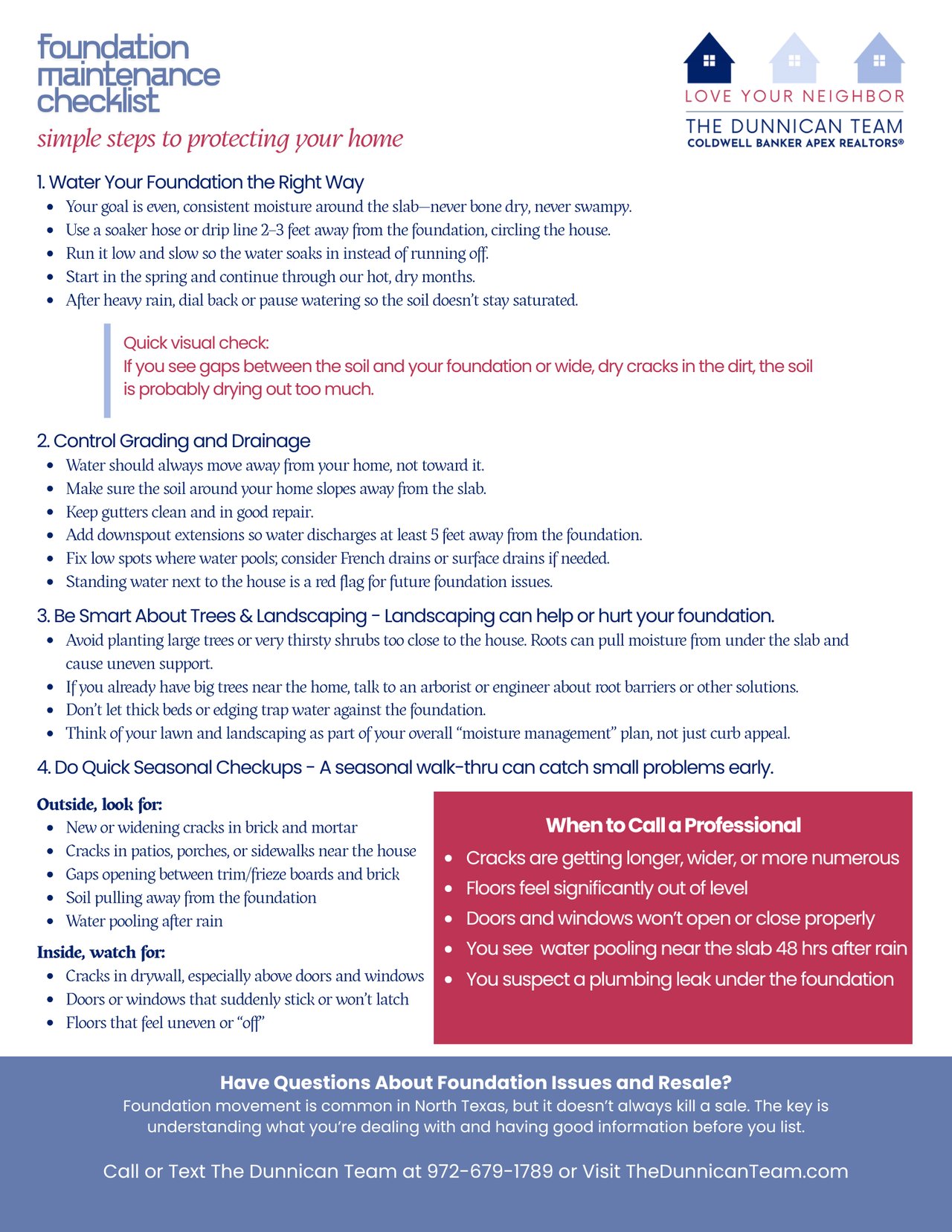
Download the Foundation Maintenance Checklist (PDF)
Homes in the Dallas–Fort Worth area are built on three primary foundation types: slab, post-tension slab, and pier & beam. Each performs differently in our expansive clay soil, and each requires slightly different maintenance. Knowing which type you have helps you focus on the right preventative steps and understand what’s normal—versus what may need attention.
A standard slab foundation is a single, continuous layer of concrete poured directly onto compacted soil.
Low maintenance
Few exposed components
Performs well when moisture levels stay consistent
Dry soil pulling away from the perimeter
Excess moisture near the slab
Drainage issues and standing water
Soil heaving during extended wet/dry cycles
Slab foundations rely on consistent soil moisture to remain stable. This guide outlines the key seasonal tasks that help minimize soil movement around your home.
A variation of a slab foundation that uses high-strength steel cables tensioned after the concrete cures.
The cables add strength and reduce cracking.
Post-tension slabs flex better with clay soil movement.
They are NOT maintenance-free—soil moisture and drainage still matter.
Keep soil moisture consistent around the perimeter.
Maintain proper drainage and avoid standing water.
Never cut, drill, or drive anchors into the slab without confirming cable locations.
Post-tension slabs are strong, but not immune to soil expansion and contraction.
Pier & beam homes sit elevated above the ground, supported by a grid of piers with a crawl space underneath.
Easier access for plumbing, electrical, and leveling.
Movement is often more correctable than with slab foundations.
Excess moisture in the crawl space
Poor ventilation
Wood rot and mold
Settling or shifting piers
Pests
Because pier & beam homes “breathe,” they require different ongoing care than slab foundations.
If you own a home anywhere in the Dallas–Fort Worth area, especially in neighborhoods across Rowlett, Rockwall, Heath, and surrounding North Texas communities, your home's foundation is resting on highly active clay soil. That soil shrinks when it dries out and swells when it’s wet, which can cause your foundation to move, crack, or tilt over time. The good news: a simple, consistent maintenance routine can dramatically reduce your risk of expensive repairs.
This guide breaks down what DFW homeowners need to do year-round to keep a slab foundation as stable as possible. Be sure to download our Foundation Maintenance Checklist below.
Much of DFW sits on “Blackland Prairie” clay – soil with a high shrink-swell potential. In dry seasons, clay contracts and pulls away from your foundation; in wet seasons, it absorbs water and expands.
Over time, those cycles can lead to:
Stair-step cracks in brick and mortar
Cracks in interior drywall
Uneven or sloping floors
Sticking doors and windows
Builders design slab foundations here to tolerate some movement, but they can’t eliminate it. Your job as a homeowner is to keep moisture and drainage as consistent as possible.
Your goal is even, consistent moisture in the soil around the slab.
Use a soaker hose or drip line 2–3 feet away from the foundation, circling the house.
Run it slowly enough that the water soaks in instead of running off.
Start your watering program in spring and continue through hot, dry periods.
Pause or reduce watering after heavy or prolonged rainfall. Too much water can be just as damaging as too little.
Quick check: If you see gaps between the soil and your foundation or wide, dry surface cracks in the dirt, you likely need more consistent watering.
Water should always move away from your house, not toward it.
Ensure the soil around your home slopes away from the foundation so rainwater doesn’t pond along the edge of the slab.
Keep gutters clean and in good repair.
Add downspout extensions so water discharges at least 5 feet away from the foundation, not into flower beds that trap water.
In low spots where water naturally collects, talk to a drainage professional or engineer about options like French drains or surface drains.
Standing water near the slab can cause heaving, settlement from oversaturated clay, and erosion — all bad news for your foundation.
Landscaping affects soil moisture just as much as your hose does.
Avoid planting large trees or thirsty shrubs too close to the foundation; roots can pull moisture out of the soil under the slab and create uneven support.
If you already have trees nearby, consider:
Adjusting your watering so they draw more water from the yard away from the foundation, not directly beside it.
Talking to an arborist or engineer about root barriers or, in some cases, selective removal.
Don’t let dense beds or edging trap water against the house.
Think of trees and landscaping as part of your overall moisture-management plan, not just curb appeal.
A quick walk-around a few times a year can catch small issues early.
Outside your home, look for:
New or spreading cracks in brick or mortar
Cracks in patios, porches, and sidewalks near the house
Gaps opening between trim/frieze boards and brick
Areas where soil has pulled away from the foundation
Places where water is pooling after rain
Inside your home, check for:
Cracks in drywall (especially above doors and windows)
Doors or windows that suddenly stick, jam, or won’t latch
Sloping or uneven flooring
If you see changes that seem to be getting worse, it’s time to call a foundation specialist or structural engineer for a professional evaluation.
Set up or adjust your foundation watering schedule.
Test sprinklers or drip lines and fix any leaks.
Confirm grading and downspouts are directing water away from the house.
Increase watering frequency during heat and drought.
Watch for soil pulling away from the foundation or wide soil cracks.
Check for new cracks or sticky doors inside the home.
Clean gutters and verify all downspout extensions are attached.
Walk the exterior after heavy rains to check for ponding water.
Trim shrubs and assess nearby trees for potential root issues.
Don’t completely stop watering; DFW can have dry spells in winter too.
Continue monitoring for new cracks or changes indoors and out.
A consistent, year-round routine beats “panic watering” after cracks appear.
Debris in the crawl space can trap moisture and attract pests.
Homeowners should ensure:
No standing water or wet soil
No piles of leaves or organic material
No construction debris
No stored items blocking airflow
A clean crawl space helps maintain proper ventilation and reduces mold or mildew risks.
Pier & beam homes are more sensitive to humidity and water intrusion.
Damp soil or standing water
Musty smells
Condensation on pipes
Sagging insulation
Mold on joists
If moisture appears repeatedly, you may need gutter extensions, improved grading, or a vapor barrier (encapsulation depends on the home and area).
Crawl space vents allow airflow that helps control humidity—but they should be adjusted seasonally.
Spring and fall, when humidity is moderate
During mild, dry weather
During winter freezes to protect pipes
During extremely wet periods
When moisture intrusion is present and being corrected
Failing to manage vents seasonally can lead to mold, wood rot, or elevated humidity.
Look for:
Cracked or leaning piers
Rotting or soft floor joists
Sagging floors
Separated beams
These issues don’t always indicate failure—they may simply suggest settling—but should be evaluated by a foundation specialist.
Just like slab homes, pier & beam homes need:
Positive grading (soil sloping away from the home)
Clean gutters and downspouts
Downspout extensions moving water 4–6 feet away
Soil moisture kept consistent around the entire perimeter
Even though the home is elevated, soil moisture still affects pier stability.
Common indicators include:
Floors that feel uneven
Doors sticking or not latching
Cracks in interior walls
Gaps between baseboards and flooring
Creaking floors
Movement in a pier & beam home is often correctable—but early detection matters.
Crawl spaces attract insects and rodents if not well maintained.
Check for:
Rodent droppings
Chewed insulation
Nesting materials
Termite tubes
Seasonal pest control helps protect wood framing.
DIY maintenance goes a long way, but you should bring in a pro when:
Cracks are getting longer, wider, or more numerous
Floors feel significantly out of level
Doors and windows stay jammed even after minor adjustments
You notice water pooling against the slab and can’t resolve it with simple grading fixes
You suspect a plumbing leak under the slab (high water bills, unexplained moisture, etc.)
Depending on the issue, you might need:
A foundation repair company to inspect the slab and provide repair options
A licensed structural engineer to evaluate movement and recommend solutions
A plumber experienced with slab leak detection and repair
Not every home needs a custom system, but many benefit from it. A properly designed sprinkler layout or a dedicated soaker hose/drip line around the house makes it much easier to keep soil moisture consistent — especially during long, hot, dry Texas summers.
Yes. Over-watering can be just as harmful as drought. Saturated clay can swell, heave, or lose bearing capacity, leading to movement just like extreme drying can. The goal is steady, moderate moisture. Pause or reduce watering after periods of heavy rain and avoid standing water near the slab.
Some hairline cracks and minor movement can be normal in North Texas because of our volatile clay soils. What’s not normal is rapid change: cracks spreading quickly, doors suddenly sticking, or visible shifts in floor level. Those are signs to get a professional opinion.
There’s no one-size-fits-all distance, since species, size, and soil conditions matter. As a general rule, large shade trees should be planted far enough away that their mature root systems aren’t aggressively pulling moisture from the soil under your foundation. If you already have trees close to the house, an engineer or arborist can advise on root barriers, watering strategies, or removal.
Foundation issues are one of the most common home concerns in the Dallas–Fort Worth area. Our region sits on expansive clay soils that swell when wet and contract during dry spells, creating constant pressure on slabs. This natural soil movement means most homes will experience some level of cracking, settlement, or shifting over time.
What surprises many homeowners is that some movement is considered normal here—hairline cracks and slight cosmetic changes happen even in well-built homes. What’s not normal is rapid or recurring movement: widening cracks, uneven floors, or doors that suddenly stop latching. Those are signs it’s time to bring in a reputable foundation specialist or structural engineer.
A properly engineered slab foundation can often last 50–100 years or more, and the concrete itself isn’t usually the limiting factor. In DFW, the real challenge is the expansive clay soil beneath the home. When that soil repeatedly swells and contracts, it places stress on the slab that can lead to movement over time.
Homes with steady moisture levels, well-managed drainage, and thoughtful landscaping typically see far fewer issues and longer-lasting performance. Even older homes can maintain a stable foundation when the surrounding soil is cared for consistently.
They’re easier to repair but require more routine moisture checks and ventilation management.
Open in moderate weather, closed during freezes or heavy rain events.
2–3 times per year, or after heavy storms.
Some homes benefit from encapsulation; others only need improved drainage. A qualified foundation specialist can evaluate humidity levels.

9106 Royal Burgess Dr Rowlett TX 75089
9106 Royal Burgess Dr Rowlett TX 75089