Contact
Office Locations
Home Office:
The Dunnican Team
9106 Royal Burgess Dr
Rowlett TX 75089
Rockwall Office:
Coldwell Banker Apex, Realtors®
2555 Ridge Road #144
Rockwall TX 75087
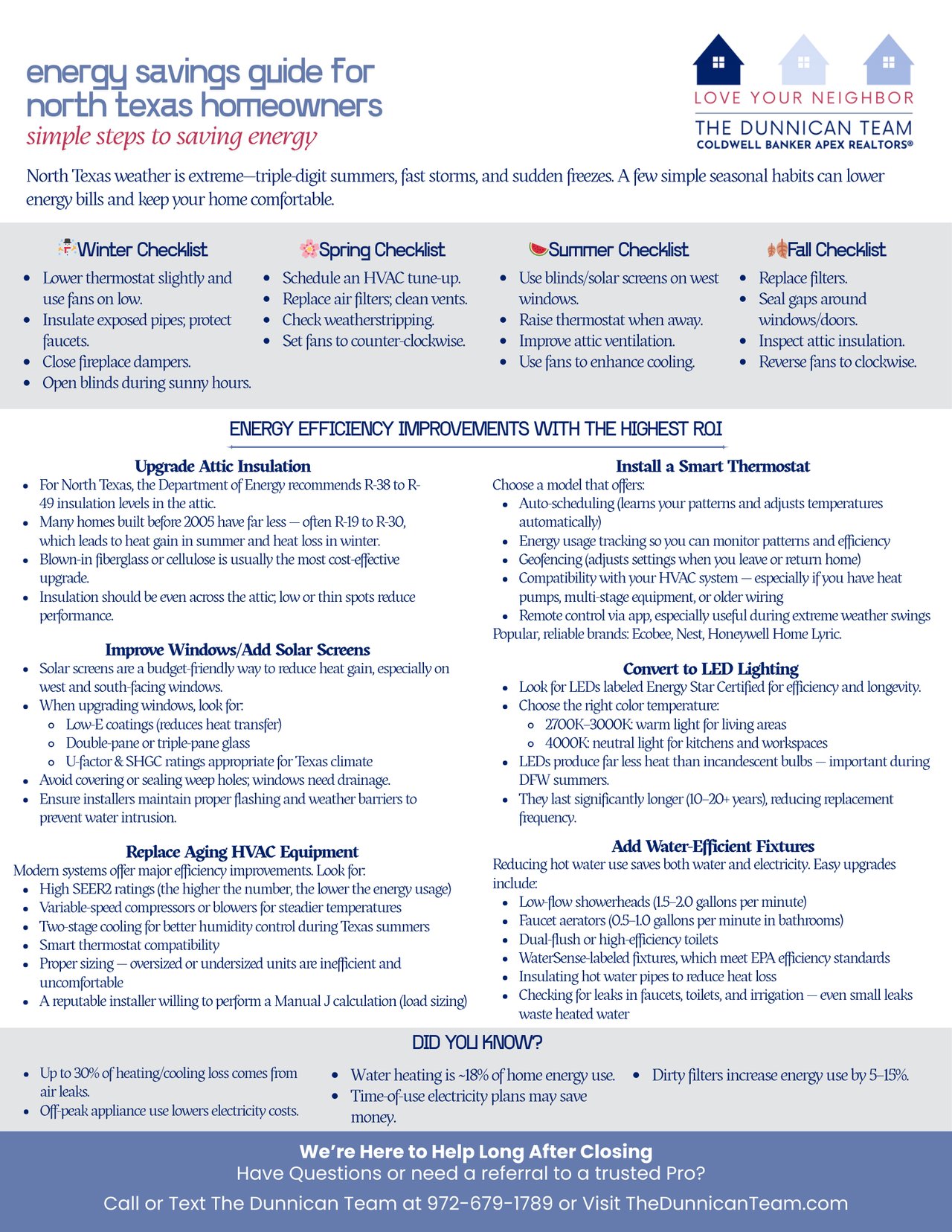
North Texas weather is extreme—triple-digit summers, fast-moving storms, and sudden winter freezes can all push your home’s systems harder than expected. The good news: a few simple, seasonal habits can help lower energy bills, protect your HVAC system, and keep your home more comfortable year-round.
This guide breaks down practical steps tailored to the DFW climate, along with cost-effective upgrades, high-ROI improvements, and helpful insights from state resources on saving electricity and water.
For more seasonal upkeep ideas, explore our Seasonal Home Maintenance Checklist and Seasonal HVAC Maintenance Guide.
Schedule an HVAC tune-up before summer demand spikes.
Replace air filters and clean supply/return vents for stronger airflow.
Check and replace weatherstripping around doors and windows.
Plant shade trees strategically to reduce summer cooling loads.
Set ceiling fans to counter-clockwise so they push cool air down.
Use these alongside your spring checklist in the Seasonal Home Maintenance Guide.
Close blinds or use solar screens on west-facing windows.
Raise your thermostat when you’re away—AC works hardest during 3–7 PM.
Improve attic ventilation to reduce attic heat buildup.
Use ceiling fans to feel 2–4° cooler without lowering the thermostat.
Review your electricity plan—fixed/variable/time-of-use options can lower bills significantly.
See the Seasonal HVAC Maintenance Guide for summer AC best practices.
Seal gaps around windows, doors, and exterior penetrations.
Inspect attic insulation; many older homes are under-insulated.
Reverse ceiling fans to clockwise to circulate warm air.
Clear leaves from around outdoor HVAC units and drainage areas.
Fall is also an ideal time to prep for heating season and storm activity.
Insulate exposed pipes and protect outdoor faucets during freezes.
Close fireplace dampers when not in use to prevent heat loss.
Open blinds on sunny days to naturally warm interior spaces.
Add weatherstripping and door sweeps to reduce drafts.
Combine these with your winter checklist in the Seasonal Home Maintenance Guide.
These upgrades offer the strongest combination of comfort, efficiency, and resale appeal:
One of the highest-ROI improvements in DFW homes. Older homes especially benefit from additional insulation.
Affordable, easy to install, and appealing to buyers. Helps reduce energy use significantly.
A low-cost upgrade that immediately reduces electricity consumption.
Reduces heat gain during our long summers and is a top buyer-requested feature.
Modern units use substantially less energy and improve both comfort and resale value.
Shading reduces AC load and improves comfort, especially on west- and south-facing sides of the home.
Low-flow fixtures, leak repairs, and irrigation audits reduce both water and energy use, since water heating is a major energy draw.
For resale-focused choices, see our Home Equity & Value-Add Projects Guide.
In North Texas, filters should typically be replaced every 30–60 days, sometimes even more frequently depending on your home. Our region has high pollen counts, dust from ongoing construction, strong wind patterns, and long AC seasons — all of which clog filters faster than in other parts of the country.
If you have pets, allergies, recent renovations, or higher-MERV filters, expect to change them on the shorter end of that range. A clean filter improves airflow, prevents strain on your HVAC system, and helps reduce energy use by 5–15%.
Absolutely. Many DFW-area homes built before 2005 were constructed with insulation levels that fall short of today’s recommended standards. Adding insulation — especially in the attic — is one of the highest-ROI energy improvements a homeowner can make.
Better insulation:
Reduces cooling and heating costs year-round
Helps stabilize indoor temperatures
Lessens the workload on your HVAC system
Increases comfort during extreme heat or cold
Is considered a value-boosting upgrade by buyers
Blown-in attic insulation is typically the most cost-effective option for our region.
Yes. Ceiling fans don’t actually change the temperature of the air — but they change how warm or cool it feels.
This allows you to adjust your thermostat by 2–4°F without sacrificing comfort:
In summer, run fans counter-clockwise to create a cooling breeze.
In winter, run fans clockwise on low to push warm air gently downward.
Because fans use only a fraction of the energy of an AC or heater, they’re one of the simplest tools for lowering monthly bills.
In summer:
Set your thermostat around 75–78°F when you’re home, and increase it 2–4° when you’re away.
Higher is fine if you’re comfortable — every degree above 72° can reduce cooling costs by 3–5%.
In winter:
Set the thermostat around 65–68°F when you’re home, and lower it 2–4° when you’re away or asleep.
Each degree below 70° can noticeably reduce heating costs.
Bottom line:
Use the highest comfortable temperature in summer and the lowest comfortable temperature in winter — and let a smart thermostat automate the schedule to maximize savings.
Because Texas is a deregulated market, many homeowners in our market area can choose their provider* — and the right plan can noticeably reduce your bill. Review these plan types:
Fixed-rate: Stable price per kWh; great for predictable bills.
Variable-rate: Price can change monthly; works best for low-usage or seasonal homes.
Time-of-use: Cheaper power during off-peak hours; ideal if you run appliances at night or weekends.
Prepaid plans: Pay-as-you-go; helpful if you prefer budget control but may be more expensive long-term.
Before switching, review your usage patterns, compare plans carefully, and avoid promotional rates that spike after the intro period.
Yes — because water heating accounts for about 18% of total household energy consumption. Reducing hot water usage directly reduces both water and energy bills.
Simple ways to save include:
Installing low-flow showerheads and faucet aerators
Washing clothes in cold water
Fixing leaks promptly (a slow leak wastes heated water)
Lowering the water heater temperature to 120°F
Using dishwasher energy-saving modes
Water efficiency is not only good for conservation; it contributes meaningfully to overall home energy savings.
Not all homeowners can choose their electricity provider. Some North Texas cities operate their own municipal electric utilities, meaning electricity is regulated locally rather than through the retail market. In these areas:
Homeowners in these cities cannot shop for retail electricity plans and must use the city-owned provider.
Many rural and semi-rural areas across Texas are served by member-owned electric cooperatives. Co-ops were allowed to opt out of deregulation—and most chose to remain regulated—meaning they continue operating as the sole electric provider within their service boundaries.
Homeowners in these co-op regions—including parts of Collin, Hunt, Kaufman, and Ellis counties—cannot choose a retail electricity provider and must receive service exclusively from their cooperative.

9106 Royal Burgess Dr Rowlett TX 75089
9106 Royal Burgess Dr Rowlett TX 75089