


How to Prepare Your DFW Home for Freezing Temperatures
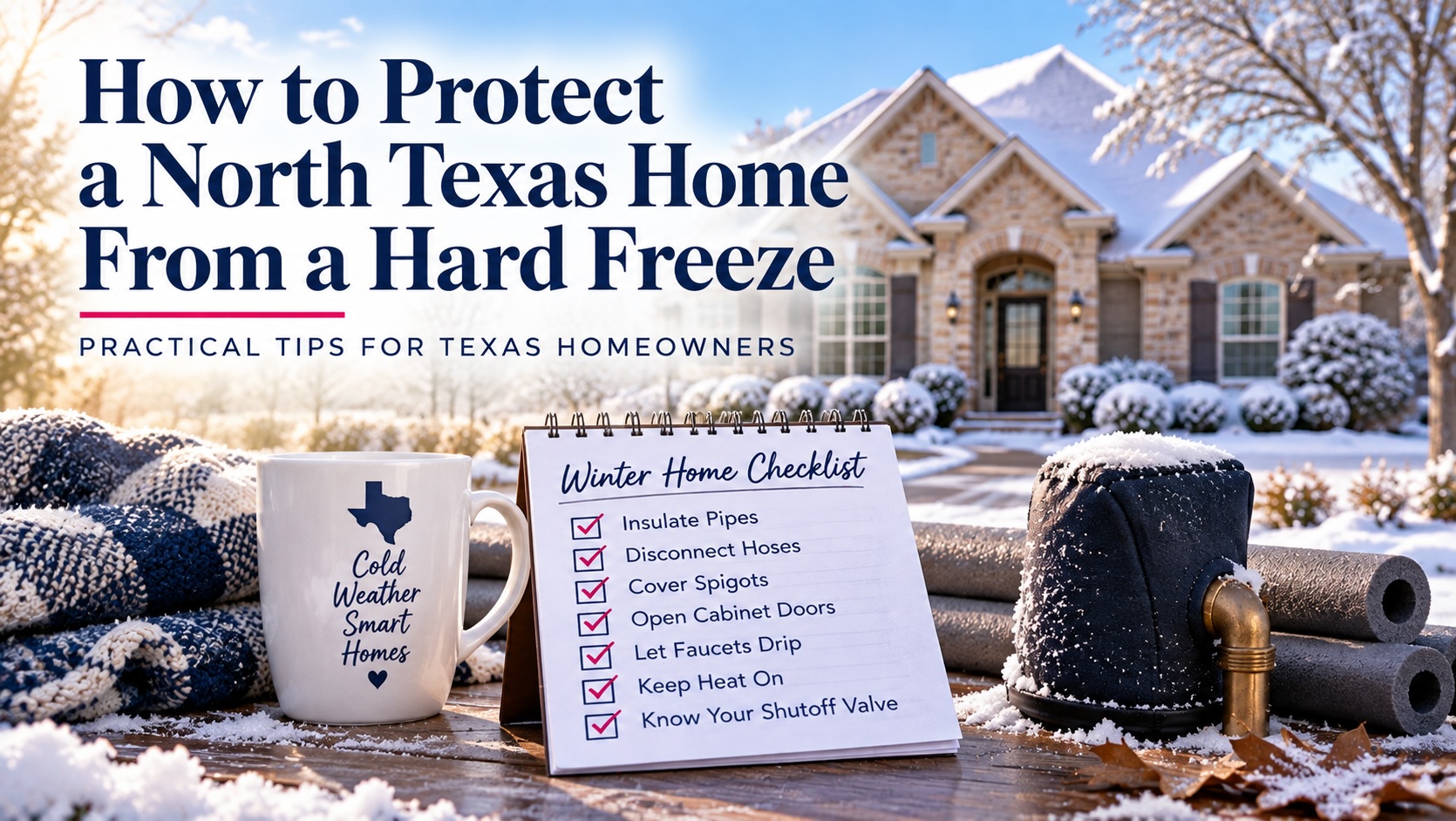
How do you protect a North Texas home from a hard freeze?
Insulate plumbing in attics, garages, and exterior walls, disconnect hoses and cover spigots, open cabinet doors under sinks, and let faucets drip. But the step that decides whether insurance pays is different: a standard homeowners policy excludes freeze damage to plumbing unless you used reasonable care to maintain heat in the home, or shut off the water and drained the system.
- Leaving town during a freeze with the heat off is the single most expensive mistake.
- Policies typically cover the water damage — but not the burst pipe itself.
- Most North Texas homes run supply lines through the attic, which is the coldest part of the house.
- A freeze repair becomes something you'll answer for on the Seller's Disclosure Notice later.
North Texas doesn't get much winter, and that's exactly the problem. Homes here are built for August, not January — supply lines run through unconditioned attics, slabs sit close to grade, and a house that shrugs off 105 degrees can lose a ceiling to eighteen hours below freezing.
The standard winterizing checklist is easy to find and worth doing. What's harder to find, and what actually determines whether a freeze costs you a weekend or thirty thousand dollars, is how your insurance policy reads and what the damage does to your house years later when you sell.
What actually fails in a North Texas freeze
Three vulnerabilities account for most of the damage here, and none are the ones people worry about.
Attic plumbing
In much of DFW, hot and cold supply lines run through the attic. In a sustained freeze the attic is colder than the outdoors overnight and the pipes have no conditioned air around them. When a line lets go up there, water runs down through insulation, drywall, and ceilings before anyone notices — which is why attic breaks cause so much more damage than an outdoor spigot.
Insulating attic runs is the highest-value hour you'll spend. Foam sleeves are inexpensive; a ceiling is not.
Exterior-wall and garage lines
Kitchen sinks on exterior walls, wet bars, laundry connections in the garage. Open the cabinet doors so household air reaches the plumbing, and leave the garage closed. If you have a water softener or a tankless unit in the garage, check the manufacturer's freeze guidance — those fail early.
Outdoor spigots and irrigation
Disconnect every hose. A connected hose traps water against the bib and the break happens inside the wall, not at the faucet. Cover the spigots. If you have an irrigation backflow preventer above ground, insulate it — those crack readily and are not cheap to replace.
Pools, and pier-and-beam crawl spaces
Pool equipment needs to run during a hard freeze, per your equipment manufacturer's guidance — pumps that stop circulating are how plumbing and heaters split. If you have a pier-and-beam home, close the crawl space vents before the freeze arrives, and remember to reopen them afterward.
What your insurance will and won't pay for
This is the part almost no winterizing article covers, and it's the one worth reading twice.
A standard homeowners policy excludes loss caused by freezing of a plumbing, heating, or air conditioning system. But the exclusion comes with an exception written directly into the form: it doesn't apply if you used reasonable care to maintain heat in the building, or shut off the water supply and drained the system.
Read that as a rule about behavior, not equipment. Two people can suffer identical burst pipes and get opposite claim outcomes. The one who kept the thermostat up is covered. The one who left for the holidays, turned the heat off to save money, and left the water on may not be.
If you travel during winter, you have two defensible choices: leave the heat on at a reasonable setting, or shut the water off at the main and drain the lines. Doing neither is the expensive option.
The second thing worth knowing: a policy generally pays for the water damage the break caused — the ceiling, the flooring, the contents — but typically not the repair or replacement of the pipe that failed. That surprises people at the worst possible moment.
There's a scenario that connects the two halves of this, and North Texas learned it the hard way in February 2021: what happens when the power goes out and you can't maintain heat?
You can't control the grid, but you can control the other branch of that exception. If an extended outage arrives during a hard freeze and the house is dropping toward freezing, shutting off the water at the main and opening the faucets to drain the lines is both the practical move and the one that keeps you inside the policy language. Know where your main shutoff is now — in the yard near the street in most North Texas homes, usually needing a meter key — rather than looking for it by flashlight at 2 a.m. A fifteen-dollar meter key in the garage is cheap insurance against a ceiling.
The rest of the outage checklist still applies: flashlights and batteries rather than candles, water stored before the storm, phones and power banks charged, a full tank of gas, and blankets in the car if you have to be on the road. Space heaters stay at least three feet from anything flammable and never run unattended.
Policies differ, and yours is the one that governs. Pull it out before the first freeze warning, read the freezing language, and call your agent about anything ambiguous. The Texas Department of Insurance publishes consumer guidance on homeowners coverage and the claims process, and it's written for people rather than adjusters.
What a freeze costs you at resale
Here's the part I see as a REALTOR® that homeowners rarely think about in February.
A freeze repair doesn't end when the drywall is patched. Under Texas Property Code § 5.008, the Seller's Disclosure Notice asks what you know about the condition of the property — including water penetration and previous repairs — completed to the best of your knowledge.
Worth being precise here, because this gets misstated: the form's flood questions are about natural flood events and reservoir releases. A burst pipe is not a flood, and it doesn't make you answer yes to those. But the repair itself is something you know about, a buyer will ask, and an inspector will often find — fresh drywall in one ceiling bay, a section of replaced supply line, a water stain that was painted over.
The sellers who have trouble are not the ones who had freeze damage. They're the ones who can't document the repair. Keep the plumber's invoice, the remediation report, and any moisture readings. A documented, properly repaired break is a non-event in negotiation. An undocumented one becomes a price reduction, because the buyer has to assume the worst.
Two adjacent things are worth understanding before you sell: what the Texas Seller's Disclosure Notice actually requires, and how repair negotiations work after an inspection — because that's where undocumented past damage costs real money. If a freeze also moved your slab, foundation issues in North Texas covers how our soils behave and what buyers and their lenders expect to see.
If selling is on your mind for next year, the work you do this winter is the same work that gets a house ready for market. Market Ready: The Ultimate Home Seller Checklist is a free room-by-room guide to preparing a home to sell, and it comes with a complimentary staging consultation.
Get the Market Ready checklistWhat's my home worth?
Or call The Dunnican Team at (972) 679-1789. Agent professional fees are fully negotiable regarding how much and who pays.
Frequently asked questions
Does homeowners insurance cover burst pipes in Texas?
Usually, with an important condition. A standard policy excludes loss caused by freezing of a plumbing system, but the exclusion does not apply if you used reasonable care to maintain heat in the building or shut off the water supply and drained the system. Policies also typically pay for the resulting water damage rather than the cost of repairing the pipe itself. Read your own policy's freezing language and confirm specifics with your agent — forms and endorsements vary.
Should I drip my faucets during a Texas freeze?
Yes. A slow, steady drip keeps water moving and relieves the pressure that actually bursts a line — a pipe usually fails from pressure between an ice blockage and a closed faucet, not from the ice itself. Drip both hot and cold, prioritize fixtures on exterior walls, and open the cabinet doors beneath sinks so household air reaches the plumbing. Dripping is a supplement to maintaining heat, not a substitute for it.
What should I do if I'm leaving town during a freeze?
Either leave the heat on at a reasonable setting, or shut off the water at the main and drain the system. Those are the two conditions that keep the freezing exclusion from applying to a claim. Turning the heat off while leaving the water on is the combination that causes both the damage and the coverage dispute. If you'll be gone more than a few days, ask someone to check the house.
Do I have to disclose freeze damage when I sell my home in Texas?
The Seller's Disclosure Notice under Texas Property Code § 5.008 asks what you know about the property's condition, including water penetration and previous repairs, answered to the best of your knowledge. The form's flood questions specifically address natural flood events and reservoir releases, so a burst pipe does not make those a yes. But damage and repairs you know about belong on the notice. Keep the plumber's invoice and any remediation documentation — a documented repair rarely affects a sale, while an undocumented one usually does.
Why do pipes freeze in the attic in Texas homes?
Many North Texas homes route hot and cold supply lines through unconditioned attic space, which is efficient to build and fine for most of the year. During a sustained freeze the attic can hold colder air than the outdoors overnight, with no conditioned air reaching the pipes. Attic breaks also cause disproportionate damage because the water travels down through insulation and ceilings before anyone notices. Insulating attic runs before winter is the most cost-effective step available in most homes here.
This article is general information for North Texas homeowners, not insurance, legal, or engineering advice. I'm a licensed REALTOR®, not an insurance agent or attorney. Insurance policy forms, endorsements, and exclusions vary — read your own policy and confirm coverage questions with your insurance agent or the Texas Department of Insurance. Texas Property Code § 5.008 is summarized as of September 2026 and may be amended. Follow your equipment manufacturer's guidance for pools, tankless heaters, and irrigation systems.
Check out this article next

How to Choose a Realtor in Rowlett, TX
Most advice about choosing an agent is the same list no matter where you live. Here's a better filter for Rowlett: ask which county the…
Read Article