

What should a Texas buyer do when the appraisal comes in below the purchase price?
If your home appraisal comes in low in Texas, you have four main options: ask the seller to reduce the price to the appraised value, pay the difference in cash out of pocket, file a Reconsideration of Value (ROV) with your lender using stronger comparable sales, or terminate the contract and recover your earnest money using the TREC Appraisal Addendum (Form 49-1). In today's Rockwall and Dallas Area market — where roughly 70% of homes are closing below list price and average days on market have stretched past 45 to 110 days — buyers have genuine negotiating leverage when appraisals fall short.
By Cindy Dunnican | June 19, 2026
You found the house. You got the offer accepted. Your loan is moving forward. Then the appraisal report lands — and it comes in $15,000 below your contract price.
This is one of the most stressful moments in a home purchase, and also one of the most misunderstood. Buyers either panic and walk away from a house they could have saved, or they assume they're stuck and cover a gap they never had to pay. Neither of those is usually the right move.
Here's exactly what's happening, what your rights are under Texas contract law, and how to think through your options — especially in today's Rockwall and DFW market.
First: Understand Why a Low Appraisal Is a Problem
Your lender doesn't just take your word for what a home is worth. They send out a licensed appraiser to independently verify the value — and their loan amount is calculated against the lower of two numbers: the appraised value or the contract price.
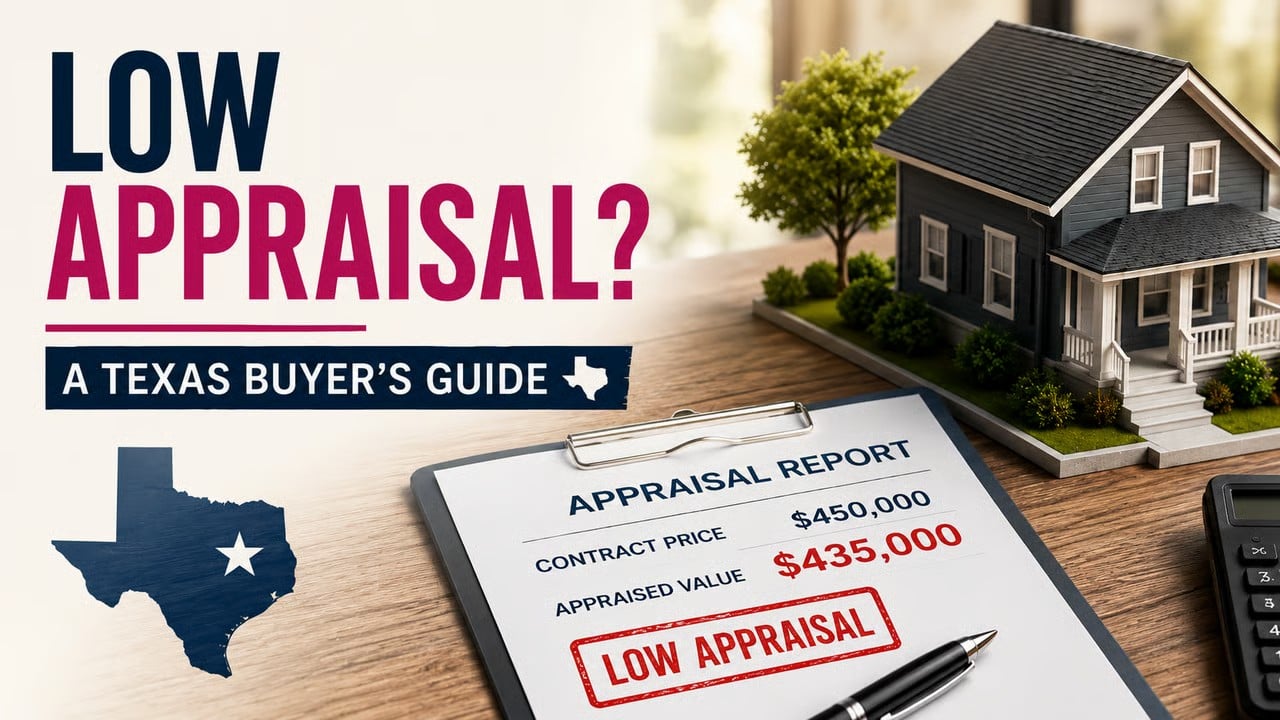
So if you're buying at $450,000 and the home appraises at $435,000, your lender bases the loan on $435,000 — not the purchase price. If you planned to put 10% down, you expected to borrow $405,000. Now the maximum loan drops to $391,500. That $13,500 difference has to come from somewhere, and it's not coming from the bank.
This is why a low appraisal creates a real problem — and why understanding your options matters before you react.
The Texas Appraisal Addendum: Know What's in Your Contract
Most Texas buyers don't know this document by name until they need it. TREC Form 49-1 — officially the Addendum Concerning Right to Terminate Due to Lender's Appraisal — is attached to many Texas purchase contracts and gives you specific protections when the appraisal falls short.
In plain language: if the home appraises below your contract price and Form 49-1 is in your contract, you can terminate the deal and receive your earnest money back.
Your agent should have included this addendum when your offer was written. If you're not sure whether they did, pull out your contract paperwork now and look for Form 49-1, or call your agent and ask directly. This document is separate from — but works alongside — the Third-Party Financing Addendum, which gives you termination rights if your lender can't complete the loan at the appraised value.
Knowing what's in your contract before the appraisal comes in is the best time to understand this. Knowing it the day after is the next best time.
Your Four Options When the Appraisal Comes In Low
Once the appraisal report lands, you and your agent need to move deliberately. Texas contract timelines keep running regardless of what's happening in negotiations. Here are your actual options:
Option 1: Ask the Seller to Reduce the Price
This is the most common resolution — and in today's Rockwall and DFW market, it's more realistic than it was in 2021 or 2022. You come back to the seller and ask them to bring the sale price down to the appraised value. The seller can agree outright, offer to split the difference, or refuse.
Here's the leverage dynamic right now: roughly 70% of Rockwall County homes are closing below list price. Sellers are averaging 45 to 110+ days on market depending on the price range. About 47% of sellers in the area have already made at least one price reduction before going under contract. A seller sitting at 60 or 90 days on market who gets a low appraisal is facing a real choice — accept the adjusted price, or relist and start over with no guarantee of a stronger offer next time.
Most will negotiate. That doesn't mean they'll absorb the full gap. But it means the conversation is worth having.
Option 2: Cover the Appraisal Gap Yourself
If the gap is manageable and the home genuinely matters to you, you can bring the extra cash to close. On a $450,000 purchase with a $15,000 appraisal gap, you'd bring that $15,000 above and beyond your normal down payment — because the lender is now working off the $435,000 appraised value.
Before you do this, make sure the gap reflects a real market difference and not just an appraisal error. If the comparable sales don't support the contract price and you're paying above market, covering the gap voluntarily means you're starting out with less equity than you thought. Have your agent pull comps before you decide.
Option 3: File a Reconsideration of Value
This is an underutilized option that works more often than buyers expect. A Reconsideration of Value (ROV) is a formal request to your lender asking the appraiser to review additional comparable sales you believe support a higher value.
The process: your agent pulls 3 recent comparable sales — ideally within the same neighborhood, similar square footage and condition, sold within the past 90 days. Your lender submits them to the appraiser, who is required to consider them before finalizing the report.
If the appraiser overlooked a relevant sale — a comparable that closed down the street last month, for example — an ROV can move the number. There's no cost to file, and the typical timeline is 5–10 business days.
An ROV won't work if the comparable sales genuinely support a lower value. But if there's a missed comp, a factual error in the report, or the appraiser used sales from a different neighborhood when better options existed, it's worth the effort before you start making financial concessions.
This is where your agent's local market knowledge matters. Pulling the right comps and framing them correctly is not something you can do effectively without someone who knows Rockwall, Rowlett, Heath, or wherever you're buying at a granular level.
Option 4: Walk Away and Recover Your Earnest Money
If the seller won't negotiate, the gap is too large to cover, and the ROV doesn't move the number — you may decide the deal isn't right at the current price. With TREC Form 49-1 in your contract, you can terminate and recover your earnest money.
This is your strongest piece of negotiating leverage. If the seller knows you're protected and genuinely willing to walk, they're far more likely to take a price reduction seriously. The option to leave the table cleanly isn't a last resort — it's part of your negotiating position from the start.
What to Do in the Next 48 Hours
If the appraisal just came in low, here's your immediate checklist:
Call your agent now — don't make any decisions before you talk it through
Confirm TREC Form 49-1 is in your contract — this determines your termination and earnest money rights
Get a copy of the appraisal report and review the comparable sales the appraiser used
Ask your agent to pull recent comps and evaluate whether an ROV makes sense
Know your financing addendum deadlines — contract timelines keep running while you're deciding
The worst response to a low appraisal is panic. The second worst is assuming you have no options. With the right information and someone who knows this market in your corner, a low appraisal is a problem that usually gets solved.
I walk buyers through this situation regularly — in Rockwall, Rowlett, Heath, and across the DFW suburbs. Every situation is a little different. The gap amount, the seller's days on market, the quality of the appraisal comps, and your own financial position all affect what the right move is. There's no universal answer, but there's almost always a path through.
Frequently Asked Questions
Can I get my earnest money back if the appraisal comes in low in Texas?
Yes — if TREC Form 49-1 (the Appraisal Addendum) is attached to your contract, you can terminate and recover your earnest money when the property doesn't appraise at the contract price. The Third-Party Financing Addendum also provides termination rights if you can't secure financing at the appraised value. Always confirm with your agent which addenda are in your contract before making any decision.
What is a Reconsideration of Value and does it actually work?
A Reconsideration of Value (ROV) is a formal request submitted through your lender asking the appraiser to review additional comparable sales. Your agent pulls 3 recent comps — ideally within the same neighborhood and sold within the past 90 days — and your lender submits them for review. The appraiser is required to consider them before finalizing the report. ROVs don't always move the number, but when the appraiser overlooked a relevant sale or made a factual error, they can be effective — and there's no cost to file.
What is the difference between the appraisal addendum and the appraisal contingency in Texas?
In Texas, the Appraisal Addendum (TREC Form 49-1) is a specific document that gives buyers the right to terminate if the lender's appraisal comes in below the purchase price. The Third-Party Financing Addendum is a broader document that provides termination rights if financing falls through — including situations where the lender reduces the loan amount due to a low appraisal. The two work together, but they're separate documents with different deadlines and conditions.
Can I order a second appraisal if mine comes in low?
You can request a second appraisal, but it must be ordered through your lender — not independently. The lender isn't required to grant the request, and the cost (typically $350–$600) is paid by the buyer. A second appraisal may come in higher, lower, or the same. Most buyers pursue a Reconsideration of Value first since it's free and faster.
How common are low appraisals in Rockwall and the DFW area right now?
Low appraisals are more common in transitioning markets — and Rockwall County is in one. With roughly 70% of homes closing below list price and sale-to-list ratios running 93–98%, there's a gap between where some sellers are pricing and where comparable sales are landing. That gap is exactly what appraisers are measuring. If a home is priced above what recent sales support, a low appraisal is a real possibility — which is why pricing strategy matters from the start.
A low appraisal doesn't have to derail your purchase. Understanding your options — and moving through them with someone who knows the local market — makes the difference between a deal that falls apart and one that closes at terms you can live with.
If you're buying in Rockwall, Rowlett, Heath, Royse City, Fate, or anywhere across the Northeast Dallas suburbs, I'm happy to walk you through where things stand and what your next move should be.
And if you're still in the early stages of your search and want to understand exactly how we guide buyers from first showing through closing day, you can download our free guide — 90 Ways We Serve Buyers — and see every step of the process.
Check out this article next