


Buying or Selling a Home With a Pool in Rockwall County
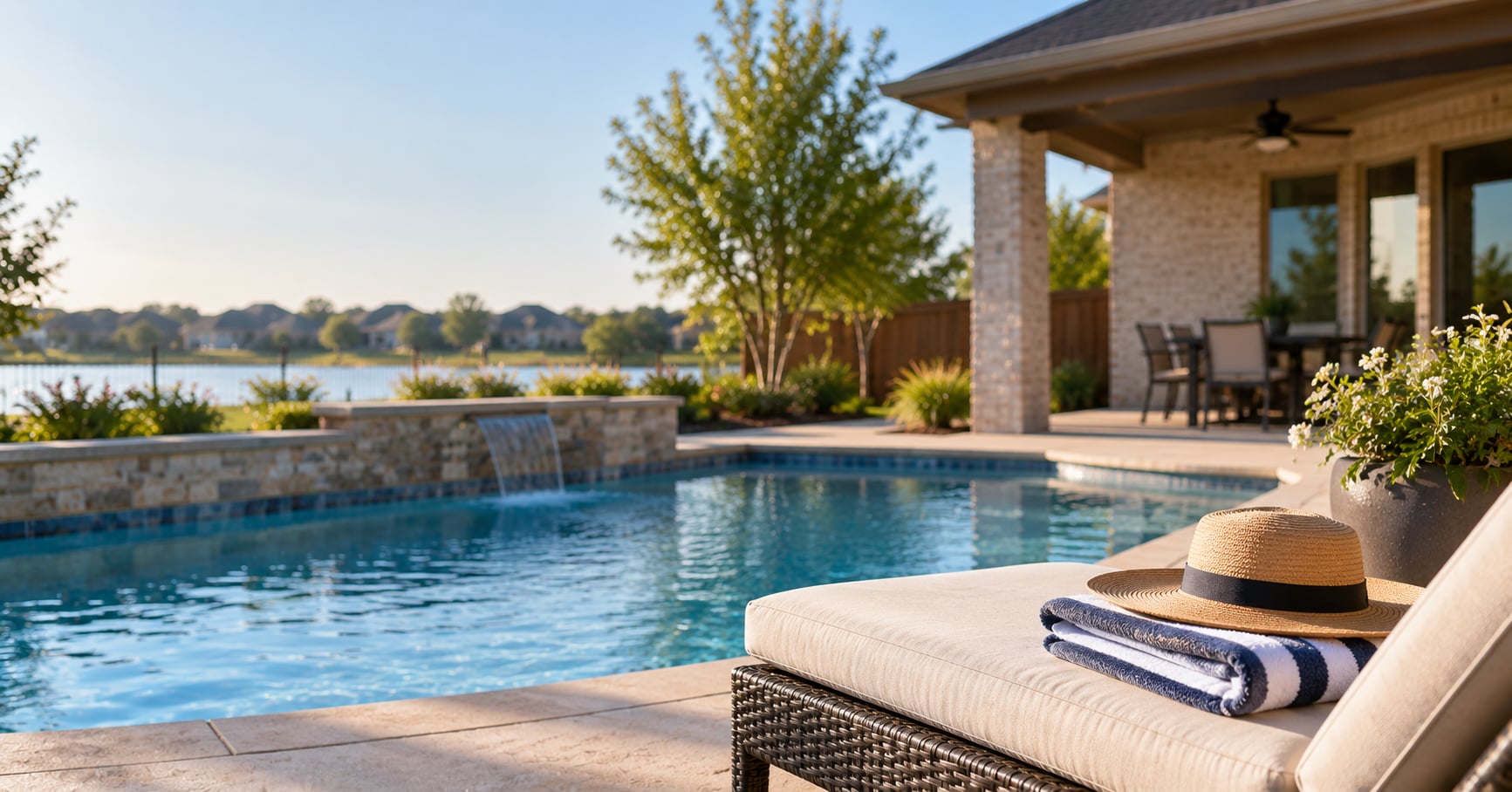
Is a pool worth it when you're buying or selling in Rockwall County?
A pool almost never returns what it cost to build, and the carrying costs surprise most buyers. Here's what actually matters on either side of a Texas contract:
- A pool inspection is not part of a standard Texas home inspection. Under the TREC Standards of Practice, pools and spas are optional components — you have to request and pay for the add-on, commonly $150 to $250 in North Texas.
- Pools raise your insurance and your tax bill. Industry estimates put the premium increase at roughly 10% to 30%, and the appraisal district adds the pool to your improvement value.
- Resale contribution is well below build cost. DFW installs commonly run $45,000 and up, while appraisers typically credit a fraction of that as contributory value.
- Your option period — usually 7 to 10 days — is the window to inspect the pool, price the repairs, and decide.
By Cindy Dunnican | September 2, 2026
A pool changes the math on a house in both directions, and not always the directions people expect.
Buyers in Rockwall, Rowlett, and Heath ask me some version of the same question every year: is the pool a bonus or a liability? Sellers ask the flip side — will I get my money back?
The honest answers are "it depends on how it's been maintained" and "probably not all of it." But there's a third answer that matters more than either one, because it's the mistake I see cost people real money: the inspection that would have caught the problem isn't included in the inspection you already ordered.
Here's how to handle a pool home on either side of the contract.
The pool inspection isn't part of your home inspection
This catches buyers every single month.
Under the TREC Standards of Practice (22 TAC §535.233), a swimming pool or spa is classified as an optional component or system. Your Texas inspector isn't required to evaluate it. Unless you specifically request the pool add-on and pay for it, it won't be in your report — and a lot of buyers don't realize that until they're reading the report and wondering where the pool section went.
In North Texas, the pool add-on commonly runs $150 to $250 on top of the general inspection fee. Many inspectors will bundle it if you ask when you schedule. Measured against a failing pump, a dead heater, or plaster at the end of its life, that's the cheapest money you'll spend in the whole transaction.
You've got the option period to get it done — typically 7 to 10 days here, with the option fee paid to the title company. That's a short window when you're also coordinating the general inspection, your financing, and possibly a survey. Order the pool inspection when you order everything else, not after you've read the general report.
Step 1 — Request the pool add-on when you schedule
Say it out loud at booking: "I need the pool and spa inspected." Don't assume it's included, and don't assume the listing agent mentioned it to anyone.
Step 2 — Confirm what the inspector actually covers
A thorough pool inspection looks at the pump, motor, filter, heater, and timer; the plaster or pebble surface, tile, coping, and decking; skimmers, valves, and visible plumbing; lighting, GFCI protection, and electrical bonding; the barrier and gates; and whether the pool has a single blockable main drain.
Step 3 — Ask the seller for records
Equipment age is the whole ballgame. Ask for service records, the date of the last resurfacing, and receipts on any pump, heater, or filter replacement. A ten-year-old variable-speed pump with paperwork is a very different purchase than a mystery pump.
Step 4 — Get repair numbers before the option period ends
If the inspection turns up problems, get at least one written bid from a pool contractor while you still have the right to terminate. You can't negotiate repairs credibly with a guess.
Barriers and gates: verify with the city, not the internet
There's a lot of confidently wrong information online about Texas pool fence law, so let's be precise.
Texas Health and Safety Code Chapter 757 — the pool yard enclosure statute people cite constantly — applies to multiunit rental complexes, condominiums, cooperatives, townhome projects, and property owners associations that own or maintain a pool. It does not govern a single-family residence.
For a single-family home in Rockwall, Rowlett, Heath, Sachse, Wylie, or Sunnyvale, the barrier requirements come from the building code your city has adopted and enforces. In practice, most local standards land in the same place: a barrier of at least 48 inches, no gaps that would let a 4-inch sphere pass through, and gates that are self-closing and self-latching. But the specifics — and whether a prior owner's pool was permitted at all — are a question for that city's building or community development department.
Two practical reasons this matters: your insurance carrier may require a compliant barrier before it will write the policy, and an unpermitted pool or a missing barrier becomes your problem the day you close.
What a pool costs you after closing
Buyers tend to budget for the purchase and not the carry. The categories to price out before your option period ends:
- Insurance. Industry estimates commonly put the increase at 10% to 30%. More importantly, pools are treated as an attractive nuisance, and the Insurance Information Institute recommends pool owners carry liability limits of at least $300,000 to $500,000. An umbrella policy — commonly $200 to $300 a year for $1 million in coverage — is worth pricing. Get a quote during the option period, not after closing, because insurance in Rockwall County is already a moving target with wind and hail deductibles.
- Property taxes. The appraisal district adds the pool to the improvement value of the home, which raises the assessed value and the tax bill. If the number looks off after you close, you can protest the appraisal.
- Routine service and chemicals. Weekly service is the norm here. Get an actual quote from a local company for that specific pool rather than a national average.
- Equipment replacement. Pumps, filters, heaters, and automation all have finite lives. This is the line item that turns a "great deal" into a five-figure year two.
- Resurfacing and tile. Plaster and pebble finishes don't last forever. If the inspection notes surface wear, ask when it was last done and price the redo.
- Energy and water. Older single-speed pumps are meaningfully more expensive to run than variable-speed equipment.
- Residential service contract. Most home warranty companies exclude pools and spas from base coverage and sell it as an optional add-on with a repair cap. If the seller is providing a service contract, read what the pool endorsement actually covers before you count on it.
What sellers need to know
Your disclosure gets more detailed with a pool. The Texas Seller's Disclosure Notice includes pool and spa items, and the Texas REALTORS® version (TXR 1406) specifically asks whether you're aware of a single blockable main drain — a suction entrapment hazard. Answer it accurately. If you don't know, say you don't know rather than guessing, and consider getting the pool inspected yourself so the answer is documented.
Price the pool honestly. DFW inground installations commonly start around $45,000 and climb well past $85,000 with features. Appraisers in pool-friendly markets often credit somewhere in the $15,000 to $40,000 range as contributory value, depending on the pool's condition, age, and how well it fits the home and lot. That gap is real, and pretending it isn't produces an appraisal problem later. This is exactly the kind of number I work through with sellers before we pick a list price, because the pool is a site improvement — its value depends on the neighborhood's price point, not on your invoice.
Condition does more work than features. A dated pool that's spotless, running clean, and backed by service records shows better and appraises better than a newer pool with cloudy water and a broken light. If you're listing in the fall or winter, keep it maintained anyway. An unmaintained pool photographs badly and reads as deferred maintenance across the whole house.
Get ahead of the safety items. Confirm the barrier and gate hardware work, address a single blockable main drain if you have one, and locate your permits. Buyers on FHA and VA financing can run into required repairs when a pool is unsafe or empty, and it's far cheaper to handle that before you're under contract than during a repair negotiation.
Every pool home is a different set of numbers. What it costs to carry, what it adds to your price, and whether it's the right buy for you depends on the specific pool, the specific house, and your specific timeline — which is why I'd rather run those numbers with you than have you rely on a national average.
Frequently Asked Questions
Does a pool add value to a home in Rockwall County? It usually adds some value, but rarely what it cost to build. Appraisers assign the pool a contributory value based on its condition, age, and how it fits the home and neighborhood — often a fraction of the installation cost. In a market where pools are common and the price point supports them, the contribution is stronger.
Is a pool inspection required in Texas? No. It's optional, and it's excluded from the standard TREC inspection unless you request and pay for the add-on. Nobody will require you to get one, which is exactly why so many buyers close on a pool they've never had evaluated.
Who pays for pool repairs found during the option period? That's negotiable, like everything else in a Texas contract. You can ask for repairs, a price reduction, or a closing cost credit — or terminate during the option period. The stronger your position, the better your written repair bids.
Do I have to disclose problems with my pool when I sell in Texas? Yes. The Texas Seller's Disclosure Notice covers pool and spa items, including whether you're aware of a single blockable main drain. Disclose what you know accurately, and don't speculate about what you don't.
Should I fill in my pool before selling? Almost never, and not without talking to an agent and your city first. Removal is expensive, it has to be done and documented properly to avoid future settlement and disclosure issues, and you'd be eliminating a feature some buyers are specifically shopping for.
Is a pool harder to insure in Rockwall County? Not harder, but more expensive and more conditional. Carriers may require a compliant barrier, and some restrict or decline diving boards and slides. Shop the quote during your option period so there are no surprises at closing.
Where to go from here
If you're selling a home with a pool and you want a straight answer on what it's actually contributing to your price, I'd be glad to put together a current market analysis. Request your free home valuation →
If you're buying and want to walk through what a specific pool home will cost you to own, download our 90 Ways We Serve Buyers guide or schedule a conversation. You can also reach us directly at (972) 679-1789.
Cindy Dunnican is the Founder and Managing Partner of The Dunnican Team at Coldwell Banker Apex, Realtors, serving Northeast Dallas, Rockwall County, and surrounding North Texas communities — including Rowlett, Rockwall, Heath, Wylie, Sachse, Fate, Royse City, Sunnyvale, and Caddo Mills. With 25+ years of experience, 1,850+ transactions, and recognition as a D Magazine D Best honoree every year since 2010, Cindy leads listings, marketing, and brand strategy for the team. She and her husband Cory Dunnican are both Global Luxury Certified and Real Trends Verified. Reach The Dunnican Team at 972-679-1789 or thedunnicanteam.com.