


Collin County Property Taxes and Your Monthly Payment
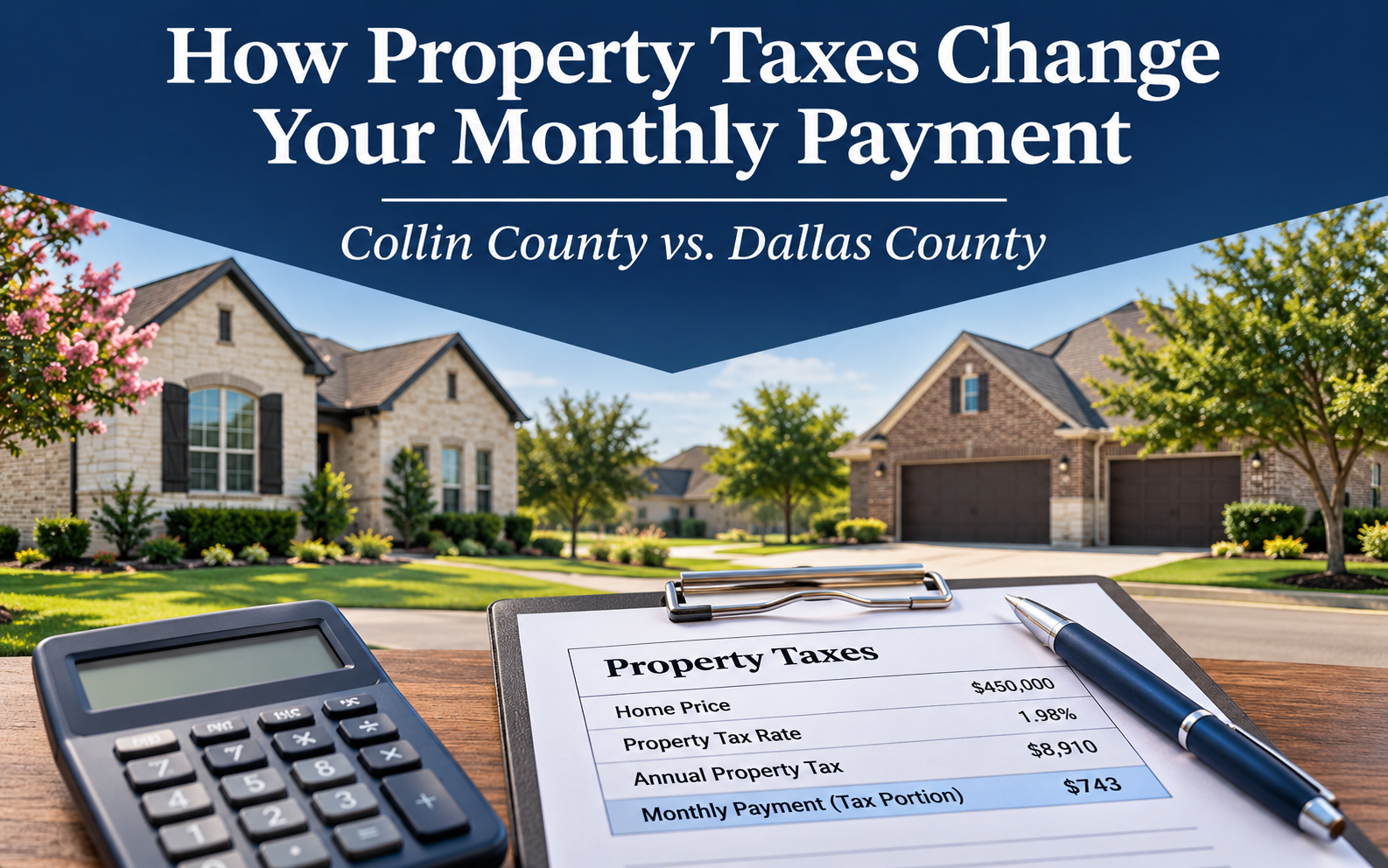
Before you compare two homes, pull each exact address and list every taxing unit attached to it. Your payment follows taxable value multiplied by those combined rates, not the single rate in an ad. Then ask your lender which value and which exemptions its tax estimate assumed.
How do Collin County Property Taxes and Dallas County taxes change my monthly payment?
Your tax bill is built from the taxable value of the home multiplied by the adopted rate of every taxing unit serving that address, so one advertised rate never tells the whole story. Collin County Property Taxes are published jurisdiction by jurisdiction, and nearby homes can sit in different combinations of county, city, school district, and special districts. Two homes at the same price a few miles apart can produce noticeably different monthly escrow amounts.
Key Takeaways
- Collin County publishes separate 2026 rates and exemptions for each city, school district, emergency-service district, road district, and other taxing entity, so there is no single "Collin County rate."
- For tax year 2026, Texas school districts must provide a $140,000 homestead exemption, and it reduces only the school-district portion of your bill.
- Texas generally caps annual homestead appraisal increases at 10%, but the cap does not protect you in your first tax year after buying.
- A seller's current tax bill is a poor forecast for a buyer, because a long-time owner's capped value can sit well below your post-purchase value.
- The tax line in a lender's payment quote is an estimate built on assumptions, so compare it to the county record for the exact address.
How do I estimate what Collin County Property Taxes will add to my payment?
Start with the exact property address, then multiply the taxable value by the combined rates of every taxing unit on that parcel and divide by twelve. That is a planning method, not a quote, but it is far more reliable than the rate printed in a listing or a city marketing page.
The county's official 2026 Tax Rates and Exemptions by Jurisdictions document shows why. It lists separate rates and exemptions for the county and for the many cities, school districts, emergency-service districts, road districts, and other entities inside it. A home near Lake Lavon cannot be judged from a city rate alone.
What are the three values I need to separate?
Price, appraised value, and taxable value are three different numbers, and only the last one drives your tax escrow.
| Value | What it means | Why it matters for your payment |
|---|---|---|
| Purchase price | What you and the seller agree on in the contract | Drives your loan amount and principal and interest, and can become the starting point for the appraisal record |
| Appraised value | The appraisal district's value for property-tax purposes | Can differ from price, and may be limited by a homestead cap once you qualify |
| Taxable value | Appraised value after applicable exemptions and limitations | The number each taxing unit applies its rate to |
Why do nearby communities have different tax stacks?
Because the stack follows the parcel, not the mailing address. A home can fall under Dallas County or Collin County, a particular city, a particular school district, and possibly a municipal utility district or emergency-service district. The searches I see most often pair Rowlett, Garland, Sunnyvale, and Richardson with Dallas County, and Wylie, Sachse, Lavon, and Murphy with Collin County. Some of those communities straddle county lines, which is exactly why the address controls the answer. I break down one example in my post on whether Sachse is in Dallas County or Collin County.
If a property sits inside a municipal utility district, that district is another taxing unit and adds to the stack. Whether a given address is in one is something to confirm from the parcel's taxing-unit list, not to assume from the neighborhood name.
I tell my buyers to talk with a lender early for a simple reason: the monthly payment is the number you live with, and the list price only gets you partway there. Before we compare homes across Rowlett, Wylie, or Lavon, I want each address's taxing units in front of us.
Which exemptions and caps actually lower my Texas property tax bill?
The biggest one is the residence-homestead exemption, but it only reduces what certain taxing units can tax, and the appraisal cap does not start on day one.
Does the $140,000 homestead exemption cover my whole bill?
No. For tax year 2026, Texas school districts must provide a $140,000 exemption on a qualifying residence homestead under Tax Code §11.13(b). That lowers the taxable value used for school-district taxes. City, county, municipal utility district, and other special-district taxes are not reduced by it.
Cities, counties, school districts, and special districts may also adopt an additional homestead exemption of up to 20% of appraised value, with a statutory minimum of $5,000. Whether your address gets one depends on the units that serve it, per the Comptroller's exemptions page. That is one more reason two similar homes can land differently.
When does the 10% homestead cap start after I buy?
The cap begins January 1 of the tax year after you first qualify. Once you qualify for the residence-homestead exemption, Texas generally limits the annual increase in appraised value to 10%, plus the market value of new improvements. The Comptroller describes the limit as applying when the property received the homestead exemption in both the preceding and current year.
In practical terms, your purchase price or current market value can become the starting point for the record, and the cap does not shield you in your first tax year. You also have to file the homestead exemption with the appraisal district and meet the eligibility requirements. It is not applied automatically.
What about owners who are 65 or older, or disabled?
Texas offers a separate school-tax ceiling for qualifying homeowners who are at least 65 or disabled. It generally limits increases in the school-district portion of the tax on the qualifying homestead after the ceiling is set. The Comptroller's publication on these protections explains how that works, including deferral options in some circumstances. If you are buying with these rules in mind, ask me and we will confirm how they apply to your situation.
Why can a bill jump after a sale?
Because the seller's capped value does not transfer to you as a forecast. A long-time owner may be paying on a value far below what the property will be appraised at after the sale. Ask for a purchase-year estimate based on likely taxable value after transfer, not the seller's current bill. I cover the same effect on newer homes in my breakdown of the year-two tax jump on new construction, which matters in growth areas like Royse City, Fate, and Lavon.
Why does my lender's tax estimate differ, and how do I compare two addresses?
The tax line in a mortgage quote is an estimate based on the lender's assumptions and escrow requirements, so it can differ from what the county eventually bills. The actual annual bill depends on the final certified appraised value, the property's taxing jurisdictions, adopted rates, exemptions, and any later corrections or supplemental charges.
Here is the sequence I use to compare homes, whether the choice is between Wylie and Sachse or a Rowlett home and a lake-adjacent one:
- Pull the parcel record from the appraisal district that covers the address (Dallas Central Appraisal District or Collin Central Appraisal District, for example).
- Confirm the current appraised value and whether an existing homestead exemption or cap belongs to the seller.
- List every taxing unit serving the parcel, then check each against the county's rate schedule. For Collin County, start with the official 2026 rate and exemption document.
- Apply the exemptions you qualify for, including the school-district homestead exemption.
- Ask your lender what it assumed: which value, which exemptions, and how escrow is set.
- Recheck after certification, once the appraisal district sets the new owner's value and exemptions.
Keep principal and interest separate from the tax escrow, homeowners insurance, mortgage insurance if it applies, and any HOA or special-district charges. Comparing only the total hides which piece moved.
Once a bill arrives, you are not stuck with the value. My guide on how to protest your property tax appraisal walks through that process, and the basics for the neighboring county are in my Rockwall County property tax guide for buyers, which is useful if Heath, Rockwall, or Royse City are on your list.
Your numbers depend on the exact parcel, your exemptions, and your loan, which is where a local search with real tax data pays off. This is the kind of comparison I walk buyers through before we ever write an offer.
The advertised rate is where the comparison starts, not where it ends. The taxing units on the parcel, your taxable value, and the exemptions you qualify for decide your monthly payment, and The Dunnican Team can pull that information for any address on your list. If you are selling a home to buy in the eastern corridor, request a free home valuation and we will plan both sides together. Buyers can call me directly at 972-679-1789 to set up a consultation.
If you want to see how clients feel about working with us, you can read Cindy's reviews on Google, Zillow, and Realtor.com.
Frequently Asked Questions
How much are property taxes in Dallas County compared with Collin County?
There is no single figure for either county, because the bill depends on the specific city, school district, and special districts at the address. Collin County lists separate 2026 rates for each jurisdiction, and Dallas County works the same way. The accurate comparison is address to address, using taxable value and the full set of rates.
Does the $140,000 Texas homestead exemption apply to every part of my property-tax bill?
No, it applies only to the school-district portion. For tax year 2026 it reduces the taxable value used for school taxes on a qualifying residence homestead. City, county, municipal utility district, and other special-district taxes are calculated separately.
When does the Texas 10% homestead appraisal cap start after I buy a house?
It begins January 1 of the tax year after you first qualify for the residence-homestead exemption. Your first tax year can therefore reflect a value based on your purchase, and the cap does not protect you yet. You must also file the exemption with the appraisal district.
Why does the tax amount on my mortgage estimate differ from the appraisal district's value?
The lender's figure is an estimate built on its own assumptions, while the appraisal district sets the official value later. The final bill depends on the certified appraised value, adopted rates, exemptions, and any later corrections. Ask your lender what value and exemptions it used so you can compare it to the county record.
Do homes in a municipal utility district have additional property taxes?
Yes, a municipal utility district is another taxing unit, so its tax is added to the stack for any parcel inside it. Whether a specific home lies in one shows up in the parcel's taxing-unit list. That is worth checking for homes near Lake Lavon and Lake Ray Hubbard before you compare monthly payments.
About Cindy Dunnican
Cindy Dunnican is the Founder and Managing Partner of The Dunnican Team at Coldwell Banker Apex, Realtors, serving Northeast Dallas, Rockwall County, and surrounding North Texas communities including Rockwall, Rowlett, Heath, Wylie, Sachse, Fate, Royse City, and Caddo Mills. With 28+ years of experience, 1,850+ transactions, and recognition as a D Magazine D Best honoree every year since 2010, she leads listings, marketing, and brand strategy for the team. She and her husband Cory Dunnican are both Global Luxury Certified and Real Trends Verified. Reach The Dunnican Team at 972-679-1789 or www.TheDunnicanTeam.com.
Coldwell Banker Apex, Realtors · 9726791789
Equal Housing Opportunity. Cindy Dunnican, Salesperson, licensed by the Texas Real Estate Commission (TREC). This article is general information, not legal, tax, or financial advice. Confirm your own numbers with your title company, tax advisor, or lender.
Check out this article next

Northeast Dallas County Housing Market Update – November 2026
17 days in one ZIP code. 51 in another. Here’s how fast homes sold across 19 Northeast Dallas County ZIP codes, August through October 2026.
Read Article