


Pre-Listing Inspection in Rowlett: Is It Worth It?
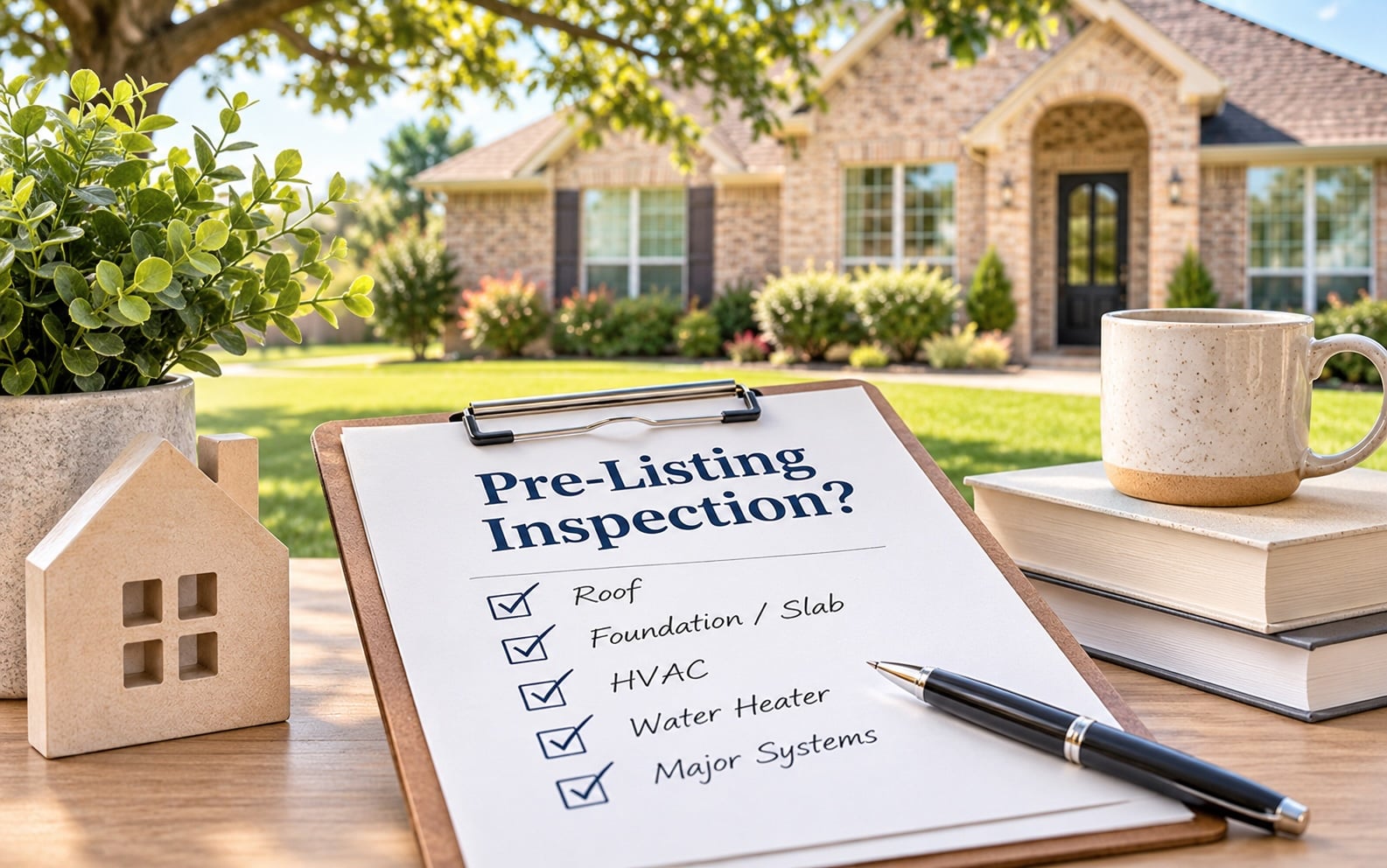
Should You Get a Pre-Listing Inspection Before Selling Your Rowlett Home?
Texas doesn't require one. Section 5.008 of the Texas Property Code requires you to give buyers a Seller's Disclosure Notice, not an inspection report, so the decision is yours. What it comes down to:
- The notice asks what you are aware of, including defects in the roof, the foundation or slab, and other structural components, so a report you've read changes what you know
- Buyers typically still inspect during their option period, so your report informs your price and your disclosures rather than replacing theirs
- Census-based figures put the typical Rowlett house at roughly 30 years old, which makes original roofs, HVAC systems, and water heaters worth a look before you list
- Decide what you'd do with a bad finding before you order, because paying for the knowledge only helps if you'll act on it
A pre-listing inspection sounds like a simple way to avoid surprises. Sometimes it is. Sometimes it hands you a document you now have to account for, on a house you were going to sell as it stands. Neither answer is right for every seller, and the honest way to decide is to understand what Texas law actually asks of you and what a report changes about it. Here's how that works for a Rowlett seller.
What Texas Requires, and What an Inspection Changes
Nothing in Texas law makes you order a home inspection before you list. What the law does require is the Seller's Disclosure Notice. Under Section 5.008 of the Texas Property Code, a seller of a residence with no more than one dwelling unit must give the buyer a written notice, either on the form TREC prescribes or one substantially similar to it. TREC's current version is Form 55-1. Section 5.008 doesn't require you to have the house inspected first.
The statute sets the standard for how you fill the notice out: to the best of your belief and knowledge as of the date you complete it. If you genuinely don't know the answer to a question, you mark it unknown, and that satisfies the section. Timing matters too. The notice is due on or before the effective date of the contract. If a buyer signs without having received it, the buyer may terminate the contract for any reason within seven days after receiving it.
That standard, belief and knowledge, is where a pre-listing inspection gets complicated. Section 2 of Form 55-1 asks whether you are aware of known defects or malfunctions in a list of items, including the roof, the foundation or slab, and other structural components, and Section 4 asks about previous structural or roof repair. As we read the current form, it asks what you know. It doesn't ask whether you've ordered an inspection, and it says on its face that it is not a substitute for any inspections or warranties a buyer may wish to obtain.
But a report you've read is information you're aware of. If an inspector writes that the slab shows movement, you can't comfortably answer "No" about the foundation afterward. That's not a reason to avoid learning about your own house, since buyers will inspect it anyway. It is a reason to decide, before you pay for a report, what you'll do with what it says. How a report interacts with your disclosure duty in your specific situation is a question for a real estate attorney, not an agent.
It also helps to know what you'd be buying. TREC's Standards of Practice for inspectors, 22 Texas Administrative Code Section 535.227, describe the inspection as a limited visual survey and basic performance evaluation that provides information about the general condition of the home at the time of inspection. The rule says it is not intended to be a comprehensive investigation or exploratory probe, and the inspector reports on the standard TREC form. A pre-listing report is a snapshot. A buyer's inspector can look on a different day and write up something different.
Rowlett adds a local wrinkle: age. Third-party sites that republish Census data put the median year built for Rowlett houses at 1996 (City-Data) or 1997 (City-Stats, citing the 2023 American Community Survey). Those aren't Census tables, so treat the exact year as approximate. They do agree on the point that matters, which is that the typical Rowlett house is about 30 years old. Anything original to the house, whether the roof covering, the HVAC system, or the water heater, is either roughly 30 years old or has been replaced, in which case you'll want the invoices and dates handy.
The market adds its own pressure. According to NTREIS MLS data on our Rowlett market update, 58 homes closed in September 2026, active listings fell 20.3% to 279, and months of inventory dropped to 4.4 from 5.8 a year earlier. That moves Rowlett into balanced territory, but mostly because fewer homes were listed, not because demand got stronger. The median sale price was $348,500, homes took a median of 59 days to go under contract and 26 more to close, and they closed at a median of 93.3% of original list price. In a market like that, a buyer has choices and often a negotiation after the inspection. How that negotiation goes is the real cost of an unknown repair, which is why the pre-listing question is worth asking at all.
Five Steps to Decide, and What to Do If You Order One
Whether a pre-listing inspection is worth it depends on your house, your timeline, and how much uncertainty you're comfortable carrying into a negotiation. This is the order we'd work through it with a Rowlett seller.
1. Write down what you already know
List every repair, replacement, and known issue on the house, with dates and invoices: roof, slab or foundation, HVAC, plumbing, electrical, and the water heater. Those answers go on the Seller's Disclosure Notice whether or not you order anything. If the list is detailed and recent, a report may add little. If you honestly don't know the condition of a major system, a report may be the only way to find out before a buyer does.
2. Decide what you'd do with a bad finding before you order
You have three realistic options when a problem surfaces: repair it before you list, price the house or offer a credit to account for it, or disclose it and sell as it stands. Our post on what selling a home as-is means in Texas covers that third route. If you wouldn't act on a finding either way, such as when you've already decided to price for condition or sell to an investor, a report may cost more than it gives you.
3. If you order one, hire a TREC-licensed inspector and read the whole report
Ask for the inspector's TREC license number and confirm it on TREC's license holder search. Ask for the standard TREC report form. Then read every page, not just the summary. You'll complete the Seller's Disclosure Notice with the report in front of you, and a finding you skimmed past is still a finding you received.
4. Complete the Seller's Disclosure Notice with the report next to you
Answer to the best of your belief and knowledge, and mark "unknown" only where you truly don't know. Deliver it on or before the contract's effective date, since a late notice gives the buyer a seven-day right to terminate. Our post on the Texas Seller's Disclosure Notice walks through the form. If a question about how to answer is more than a wording issue, that's the point to ask an attorney.
5. Price and market with the report in hand, and expect the buyer to inspect anyway
A buyer's option period typically runs 7 to 10 days, and the option fee is paid to the title company, not to you. Inside that window the buyer's inspector will write their own report and the buyer may ask for repairs or credits. Our guide to negotiating repairs after a home inspection in Texas and the post on the Texas option period cover that stage. The advantage of having done your own work first is specifics: documented repairs, receipts, and a price that already reflects what's wrong, so the conversation starts from facts rather than from a buyer's first impression.
There's no universal answer. An inspection makes more sense when you don't know the condition of the major systems and you'd act on what you learn, and less when you already know the big item or you're selling as-is. For more on preparing a house for market, see our North Texas home inspection resource for sellers and the Rowlett home selling guide.
Wondering what your Rowlett home would sell for as it stands today? Start with a Free Home Valuation. If you'd like to talk through whether an inspection makes sense before you list, schedule a time to talk with Cindy, or call The Dunnican Team at (972) 679-1789. You can also use the Market Ready seller checklist to plan your prep.
Frequently Asked Questions
Does Texas require a home inspection before you sell?
No. Section 5.008 of the Texas Property Code requires most sellers of residences to give the buyer a Seller's Disclosure Notice. It doesn't require the seller to have the home inspected first. Buyers usually order their own inspection after the contract is signed.
If I get a pre-listing inspection, do I have to give the report to buyers?
The statute and TREC's current Form 55-1, as we read them, don't ask for an inspection report to be attached. Whether to share a report is a decision to make with your agent, and an attorney if you want a legal opinion. What the notice does require is that your answers reflect your best belief and knowledge, and a report you've read is part of what you know.
Will a buyer still inspect if I already did?
In most cases, yes. A buyer isn't bound by your inspector's findings, and the option period, typically 7 to 10 days with the option fee paid to the title company, exists so the buyer can inspect and negotiate. Your report affects your price and your preparation. It doesn't remove the buyer's inspection.
How much does a Rowlett listing agent charge?
Agent professional fees are fully negotiable regarding how much and who pays. Ask any agent you interview to explain how their fee is set and what it covers before you sign a listing agreement.
Cindy Dunnican is the Founder and Managing Partner of The Dunnican Team at Coldwell Banker Apex, Realtors, serving Northeast Dallas, Rockwall County, and surrounding North Texas communities — including Rowlett, Rockwall, Heath, Wylie, Sachse, Fate, Royse City, Sunnyvale, and Caddo Mills. With 28+ years of experience, 1,850+ transactions, over $350M in career sales volume, and recognition as a D Magazine D Best honoree every year since 2010, Cindy leads listings, marketing, and brand strategy for the team. She and her husband Cory Dunnican are both Global Luxury Certified and Real Trends Verified. Reach The Dunnican Team at 972-679-1789 or thedunnicanteam.com.
This article is provided for general informational purposes only and does not constitute legal advice. Texas Property Code Section 5.008, TREC Form 55-1, and TREC's inspector Standards of Practice may change, so confirm the current versions with TREC or a licensed Texas attorney before you rely on them. Housing-age figures come from third-party sites that republish Census data and are approximate. Market figures are from NTREIS MLS data for September 2026 and change monthly.
Check out this article next

Rockwall Home Value and What Online Estimates Miss
Start by treating any online number as a rough draft. Before you rely on it, check what it assumes about your condition, lake access, and…
Read Article