


Useful Tips for DFW Homeowners
Seasonal HVAC Maintenance Checklist
Your heating and cooling system works harder in North Texas than in almost any other part of the country — eight months of cooling, then sudden cold fronts that put the furnace to work overnight. Regular seasonal care extends the life of the system, keeps energy costs in check, and prevents the failures that always seem to happen on the hottest day of the year.
Download the Seasonal HVAC Maintenance Checklist below.
How to Stay Ahead of HVAC Problems in DFW
Your HVAC system works harder here than in most of the country. Cooling season runs eight months, and then a cold front drops forty degrees overnight and the furnace takes over. Add the dust and pollen our springs are known for, and the equipment in a North Texas home ages faster than the manufacturer's estimate suggests.
Most failures give warning first — longer run times, weaker airflow, a smell that wasn't there last week, a unit that cycles more often than it used to. Catching those signals is the difference between a service call in April and a replacement in August, when every HVAC company in the metroplex is booked solid.
This guide covers what to do each season, what a professional tune-up should actually include, and when a repair stops being worth it. Download the Seasonal HVAC Maintenance Checklist below to keep with your home records.
Why Seasonal HVAC Maintenance Matters in DFW
Our climate swings from triple-digit summers to sudden cold fronts, which makes your HVAC system one of the hardest-working parts of your home. Regular seasonal maintenance helps you:
- Reduce energy use and keep monthly bills in check.
- Extend the lifespan of your equipment.
- Prevent emergency repairs during peak season, when service calls are hardest to get.
- Improve indoor air quality in a region known for dust and allergens.
- Keep warranties valid — most manufacturers require maintenance records.
Just like caring for your home's structural systems, such as in our DFW Foundation Maintenance Guide, consistent HVAC upkeep protects your investment and your comfort.
Seasonal HVAC Maintenance Checklist for DFW Homeowners
Seasonal HVAC Checklist
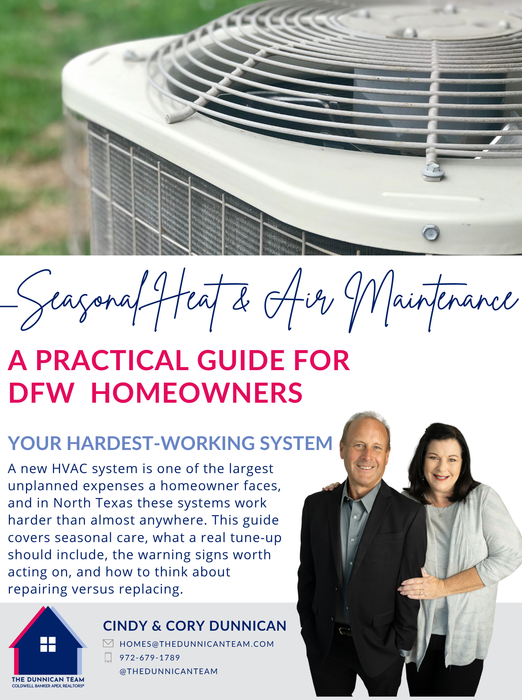
Your HVAC system runs roughly twice as many hours a year in DFW as it would in a cooler climate — which is why systems here wear out faster than the manufacturer's estimate suggests. This 2-page printable checklist covers what to do monthly, what changes between cooling and heating season, and what a professional tune-up should actually include, so you know whether you're getting what you paid for.
Seasonal HVAC Maintenance Checklist (DFW Edition)
Here's the full checklist, season by season. The monthly items take a few minutes and catch most problems early. The seasonal work splits into what you can do yourself and what belongs to a licensed technician — both matter, and the professional visits are where the expensive failures get caught.
- Replace or clean air filters — more often with pets, allergies, or heavy dust.
- Check thermostat batteries.
- Make sure vents and returns aren't blocked by furniture, rugs, or curtains.
DFW summers push AC systems harder than almost anywhere else. Preparing early helps you get through the hottest months without service interruptions.
1. Replace Your Air Filter
A clean filter improves airflow, reduces strain, and keeps energy bills manageable.
- MERV 8–12 filters offer the best balance of airflow and filtration.
- Higher MERV isn't always better — older systems may struggle with the airflow restriction.
2. Clear and Clean the Outdoor Condenser Unit
- Remove leaves, grass, and debris.
- Keep at least 2 feet of clearance around the unit.
- Check that the condenser pad hasn't shifted or sunk.
3. Inspect and Maintain the Condensate Drain Line
With the high summer temps, this line works overtime.
- Pour ½ cup of distilled vinegar into the drain monthly.
- Watch for backups that can cause water leaks and system shutdowns.
4. Inspect Refrigerant Line Insulation
Cracked or missing insulation reduces cooling efficiency.
5. Schedule a Professional AC Tune-Up
A licensed HVAC technician should check:
- Refrigerant levels
- Temperature differentials
- Coils, both evaporator and condenser
- Electrical components
- Blower assembly
- System pressure
Early-season tune-ups prevent surprise failures when demand spikes — and they're far easier to book in March than in July.
Cold fronts arrive quickly in DFW. Preparing your system ensures steady, safe heating.
1. Change the Filter Before First Use
A fresh filter reduces burnt-dust odors and improves airflow.
2. Expect a Light Burning Smell on Your First Heat Cycle
A mild dust smell is normal. Strong, electrical, smoky, or chemical odors are not. If the smell doesn't clear within a few minutes, turn the system off and call a professional.
3. Check the Furnace Flame (Gas Systems)
- A steady blue flame indicates proper combustion.
- Yellow or flickering flames can signal ventilation or safety issues.
4. Keep the Area Around the Furnace Clear
Avoid storing boxes, paint, chemicals, or flammable materials nearby.
5. Schedule a Professional Furnace Inspection
Your technician should review:
- Burners and ignition
- Gas pressure
- Heat exchanger condition
- Safety switches and sensors
- Blower motor performance
Heating problems often develop quietly — early detection saves money and, with gas systems, matters for safety.
Repair or Replace? How to Think About It
At some point every system reaches the question, usually at the worst possible moment. A few things make the decision clearer.
Start with age
Most DFW systems last 10 to 15 years. That's shorter than the national average for a reason: a home here runs its air conditioning roughly 2,200 to 2,500 hours a year, against about 1,200 in a cooler climate. Well-maintained systems tend to reach the upper end of that range. Neglected ones often fail closer to 10.
Under 10 years, repair is usually the right call. Past 15, you're maintaining borrowed time. The years in between are where judgment matters.
Weigh the repair against the replacement
A common rule of thumb: multiply the repair cost by the system's age. If the result exceeds the cost of a new system, replacement usually makes more sense. It's a rough guide, not a formula — but it keeps a $1,800 repair on a 14-year-old unit in perspective.
Watch for the expensive failures
Compressor failure and a cracked heat exchanger are the two repairs that most often tip the decision. Both are costly, and both tend to arrive when a system is already near the end of its life. If either comes up on an older system, get a replacement quote alongside the repair estimate before you decide.
Consider what you're actually paying for
A newer, properly sized system runs more efficiently, which shows up on eight months of cooling bills. It also removes the risk of a failure in August, when every HVAC company in the metroplex is booked out. Neither of those appears on a repair invoice, but both are real.
Get more than one opinion on a replacement
Replacement is a significant expense, and sizing matters as much as brand — an oversized system short-cycles and wears out faster than a correctly sized one. Two or three quotes is standard practice, and any reputable company will expect it.
If you're weighing a replacement and wondering how it affects your home's value or a future sale, that's a conversation we're glad to have. Call or text 972-679-1789.
Common HVAC Issues in North Texas
DUST AND DEBRIS
North Texas is dusty in a way that surprises people who move here. Ongoing construction, open land, and steady wind push fine dust into your return system faster than filters are designed to handle, and spring adds a heavy pollen load on top of it. The result is filters that clog well before the label says they should — which restricts airflow, makes the system work harder, and eventually coats the coils, where it takes a technician to clean.
Blocked Condensate Lines
Algae and debris build up in the condensate line over a long cooling season and block the drain. When that happens, water backs up into the pan and either overflows — often into a ceiling or attic floor — or trips the safety switch and shuts the system down entirely. Most homeowners discover it as a water stain or a system that quit on a hot afternoon.
SUDDEN ENERGY BILL SPIKES
A jump in kwh with no change in weather or usage usually points to a dirty filter, duct leaks, low refrigerant, or a system losing efficiency with age. In DFW, duct leaks are the quiet one — most ductwork runs through an attic that hits 130 degrees in summer, so even small leaks pull superheated air into the system.
FROZEN COILS (SUMMER)
Ice on the coil in August sounds impossible, but it's a common failure. Restricted airflow or low refrigerant makes the coil too cold, and condensation freezes.
Usually caused by:
- A dirty or clogged filter
- Blocked return or supply vents
- Low refrigerant, which almost always means a leak
- A failing blower motor
If the system runs but doesn't cool, shut it off and let it thaw before calling. Running it frozen can damage the compressor.
FAQs About Seasonal HVAC Maintenance
Every 30 to 60 days, depending on filter type, dust levels, pets, and allergies. Standard one-inch filters need changing more often than thicker media filters. During heavy AC use, check monthly.
Most homes do well with MERV 8–12. Higher ratings filter more but restrict airflow, and an older system may struggle with that restriction — which can cost you more in strain than you gain in filtration.
Yes. Professional service catches the problems you can't see — refrigerant levels, electrical connections, heat exchanger condition — before they become failures during a temperature extreme. Most manufacturers also require documented maintenance to keep a warranty valid.
Dust settles on the heat exchanger over the summer and burns off during the first heat cycle. A mild smell that clears within a few minutes is normal. If it's strong, smoky, electrical, or persistent, shut the system off and call a technician.
Pour ½ cup of distilled vinegar into the drain monthly during cooling season, and keep the area around the line clear of debris. A clogged line can back up, leak, and shut the system down — often on the hottest day of the year.
Common causes include a dirty filter, duct leaks, low refrigerant, poor attic insulation, or a system that's simply losing efficiency with age. A sudden jump with no change in weather or usage is worth a service call.
Most DFW systems last 10 to 15 years — shorter than the national average, because a home here runs its air conditioning roughly 2,200 to 2,500 hours a year compared to about 1,200 in cooler climates. Well-maintained systems tend to reach the top of that range; neglected ones often fail closer to 10. Frequent repairs, rising bills, and uneven cooling are the signals worth an evaluation.
The Complete Seasonal HVAC Checklist
Here's everything in one place. The monthly items take a few minutes and catch most problems early. The seasonal work splits into what you can do yourself and what belongs to a licensed technician — both matter, and the professional visits are where the expensive failures get caught.
Every month
- Replace or clean air filters — more often with pets, allergies, or heavy dust.
- Check thermostat batteries.
- Make sure vents and returns aren't blocked by furniture, rugs, or curtains.
Spring & summer (cooling season)
DFW summers push AC systems harder than almost anywhere else. Preparing early helps you get through the hottest months without service interruptions.
Replace your air filter
- A clean filter improves airflow, reduces strain, and keeps energy bills manageable.
- MERV 8–12 filters offer the best balance of airflow and filtration.
- Higher MERV isn't always better — older systems may struggle with the airflow restriction.
Clear and clean the outdoor condenser unit
- Remove leaves, grass, and debris.
- Keep at least 2 feet of clearance around the unit.
- Check that the condenser pad hasn't shifted or sunk.
Inspect and maintain the condensate drain line
- With the high summer temps, this line works overtime.
- Pour ½ cup of distilled vinegar into the drain monthly.
- Watch for backups that can cause water leaks and system shutdowns.
Inspect refrigerant line insulation
- Cracked or missing insulation reduces cooling efficiency.
Schedule a professional AC tune-up
A licensed HVAC technician should check:
- Refrigerant levels
- Temperature differentials
- Coils, both evaporator and condenser
- Electrical components
- Blower assembly
- System pressure
Early-season tune-ups prevent surprise failures when demand spikes — and they're far easier to book in March than in July.
Fall & winter (heating season)
Cold fronts arrive quickly in DFW. Preparing your system ensures steady, safe heating.
Change the filter before first use
- A fresh filter reduces burnt-dust odors and improves airflow.
Expect a light burning smell on your first heat cycle
- A mild dust smell is normal.
- Strong, electrical, smoky, or chemical odors are not.
- If the smell doesn't clear within a few minutes, turn the system off and call a professional.
Check the furnace flame (gas systems)
- A steady blue flame indicates proper combustion.
- Yellow or flickering flames can signal ventilation or safety issues.
Keep the area around the furnace clear
- Avoid storing boxes, paint, chemicals, or flammable materials nearby.
Schedule a professional furnace inspection
Your technician should review:
- Burners and ignition
- Gas pressure
- Heat exchanger condition
- Safety switches and sensors
- Blower motor performance
Heating problems often develop quietly — early detection saves money and, with gas systems, matters for safety.